
From Toxic Effluent to Reusable Water: The New Era of Paper Mill Wastewater Treatment
- MARKETING BIOSYNK
- May 9
- 5 min read

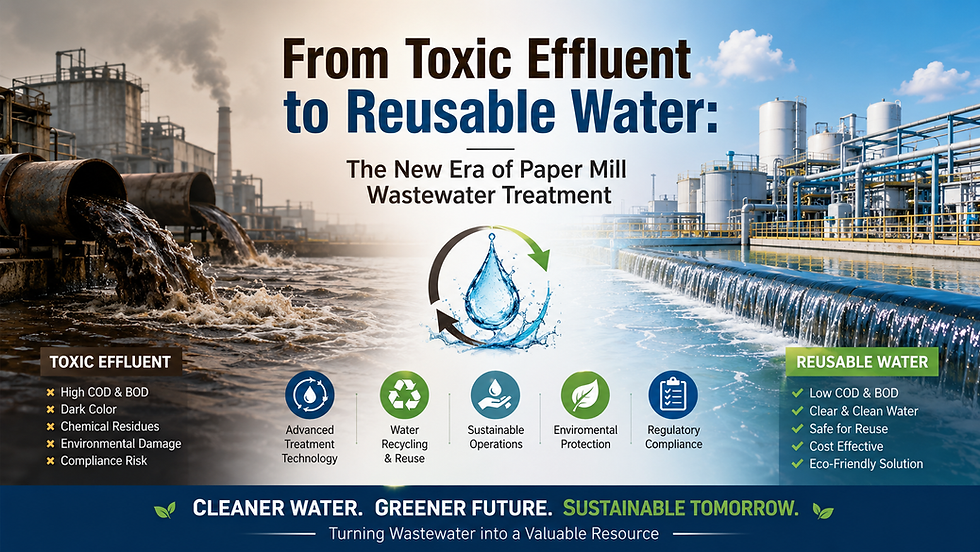
India’s paper and pulp industry is expanding faster than ever. From packaging materials and cardboard boxes to tissue paper, printing sheets, and industrial paper products — demand is exploding across every sector. But behind this industrial growth lies a silent environmental disaster that many factories still struggle to control:
Toxic wastewater discharge.
Every paper mill generates massive quantities of dark-coloured effluent filled with lignin, bleaching chemicals, suspended fibers, chlorinated compounds, high COD, high BOD, sludge, and toxic organic pollutants. Traditional treatment systems are failing. Rivers are turning black. Groundwater is becoming unsafe. Regulatory pressure is increasing. And industries are now facing one unavoidable question:
How can paper mills transform toxic wastewater into reusable water while staying compliant and profitable?
The answer lies in advanced wastewater treatment technology.
Today, forward-thinking industries are no longer viewing wastewater as “waste.” They are treating it as a reusable resource — and companies that fail to adapt may soon face operational shutdowns, rising penalties, water shortages, and severe brand damage.
Modern paper mills are entering a completely new era of wastewater management — where treated effluent becomes reusable process water instead of an environmental liability.
Why Paper Mill Wastewater Is One of the Most Difficult Industrial Effluents to Treat
Paper mill wastewater is far more complex than ordinary sewage.
It contains:
High COD and BOD load
Dark brown or black colour caused by lignin
Bleaching chemicals
Suspended pulp fibers
Chlorinated compounds
Toxic dissolved organics
Foam and sludge
High TDS in some operations
According to industry research, paper and pulp wastewater is among the most heterogeneous and toxic industrial effluents, requiring hybrid and advanced treatment methods for long-term sustainability.
The biggest challenge?
Even after conventional treatment, the water often still looks dark and polluted.
Many industries mistakenly believe that reducing COD alone is enough. But pollution control authorities are now focusing heavily on:
Colour removal
Water reuse capability
ZLD readiness
Sludge reduction
Environmental impact
Long-term sustainability
This is why outdated Effluent Treatment Plants (ETPs) are rapidly becoming ineffective.
The Hidden Crisis Most Paper Mills Don’t Talk About
Many paper industries are currently facing serious operational problems:
1. Treated Water Still Looks Brown
This is one of the biggest complaints from paper mills. Conventional systems fail to remove persistent colour compounds caused by lignin derivatives.
2. Rising Chemical Consumption
Industries are spending huge amounts on chemicals just to achieve partial compliance.
3. RO Membrane Choking
Poorly treated wastewater damages RO systems and increases maintenance costs.
4. Pollution Control Board Pressure
Environmental norms are becoming stricter every year. Non-compliance can lead to penalties, production stoppages, and legal notices.
5. Freshwater Shortage
Industries depending entirely on freshwater are now facing severe water insecurity.
6. High Sludge Generation
Traditional systems generate excessive sludge, creating disposal problems and rising operational expenses.
Why Conventional ETP Systems Are Failing
Most old wastewater treatment systems were designed for a different industrial era.
Traditional systems typically include:
Primary clarification
Basic aeration
Conventional activated sludge process
Chemical dosing
While these methods remove some solids and organic matter, they struggle with:
Stable colour removal
Reuse-quality water production
High-load COD reduction
Advanced contaminant removal
ZLD compatibility
Modern paper mills require advanced multi-stage treatment systems capable of handling fluctuating wastewater characteristics efficiently.
The New Era of Paper Mill Wastewater Treatment
The industry is now moving toward intelligent wastewater recycling systems designed not only for treatment — but for transformation.
The goal is simple:
Convert toxic effluent into reusable industrial water.
This new generation of wastewater treatment combines:
Advanced biological treatment
Anaerobic digestion
High-efficiency clarification
Colour removal technology
Advanced oxidation processes
Tertiary filtration
Membrane polishing
Water reuse systems
The result?
✔ Cleaner discharge
✔ Reduced freshwater dependency
✔ Lower operating costs
✔ Easier PCB compliance
✔ Sustainable operations
✔ Future-ready manufacturing
Can Paper Mill Wastewater Really Be Reused?
Yes — and this is becoming essential for industrial survival.
Modern wastewater treatment systems can recycle treated water for:
Cooling systems
Process reuse
Utility applications
Boiler feed pre-treatment
Floor washing
Gardening
Industrial cleaning
This dramatically reduces freshwater consumption and operating expenses.
As global water stress intensifies, industries adopting water reuse strategies will gain major economic and regulatory advantages.
The Environmental Impact Nobody Can Ignore Anymore
Untreated industrial wastewater doesn’t disappear.
It enters:
Rivers
Lakes
Agricultural land
Groundwater
Drinking water sources
Recent reports across India continue to highlight severe pollution caused by untreated industrial discharge and sewage contamination.
When paper mill wastewater enters natural ecosystems:
Oxygen levels drop
Aquatic life dies
Groundwater becomes unsafe
Cancer and health risks increase
Soil fertility declines
Entire communities suffer
This is no longer just an environmental issue.
It is a public health crisis.
Why 2026 Is Becoming a Turning Point for Paper Mills
Several major industry shifts are happening simultaneously:
Stricter Environmental Regulations
Pollution boards are increasing inspections and compliance enforcement.
Water Scarcity Is Increasing
Industries can no longer depend endlessly on freshwater sources.
ESG Pressure Is Rising
Global clients now prioritize environmentally responsible suppliers.
Zero Liquid Discharge (ZLD) Is Expanding
Many industrial zones are moving toward mandatory water reuse and discharge reduction.
Sustainable Manufacturing Is Becoming a Competitive Advantage
Companies with advanced wastewater recycling systems are winning global trust faster.
One Solution That Solves Multiple Problems
Modern advanced wastewater treatment systems for paper mills can simultaneously solve:
Problem | Advanced Solution |
Dark coloured discharge | Advanced colour removal |
High COD/BOD | Biological + oxidation treatment |
RO membrane failure | Better tertiary polishing |
Water shortage | Water recycling & reuse |
PCB compliance issues | Stable treatment performance |
Excess sludge | Optimized process control |
Rising operating costs | Reduced chemical & freshwater use |
Sustainability pressure | Eco-friendly wastewater management |
Why Industries Are Moving Toward Smart Wastewater Recycling Systems
Forward-thinking industries now understand something critical:
Wastewater treatment is no longer just a compliance expense.
It is a long-term business investment.
Benefits include:
Lower freshwater purchase costs
Reduced environmental penalties
Better operational stability
Higher ESG value
Improved brand reputation
Long-term sustainability
Better investor confidence
Future-ready industrial infrastructure
The Future Belongs to Water-Recycling Industries
The industries that survive the next decade will not simply be the ones producing the most.
They will be the ones using water intelligently.
Paper mills that continue using outdated treatment systems may soon face:
Regulatory shutdowns
Water shortages
Rising costs
Public backlash
ESG failures
Production instability
Meanwhile, industries investing in advanced wastewater recycling are creating sustainable, profitable, and future-ready operations.
Why BioSynk Is Becoming a Trusted Partner for Paper Mill Wastewater Treatment
BioSynk Wastewater Treatment for Paper & Pulp Mills
BioSynk Official Websitehttps://www.biostp.co.in/
BioSynk provides advanced wastewater treatment solutions specially designed for paper and pulp industries facing:
Colour removal challenges
High COD wastewater
Reuse difficulties
ETP inefficiencies
Compliance pressure
RO membrane issues
Rising water costs
Their advanced treatment approach focuses on:
✔ Wastewater recycling
✔ Colour reduction
✔ Compliance achievement
✔ Sustainable operation
✔ Long-term performance optimization
✔ Water reuse enablement
Unlike conventional systems, BioSynk focuses on transforming industrial wastewater into reusable water while helping industries move toward a cleaner and more sustainable future.
Conclusion: Every Drop Recycled Is a Step Toward Industrial Survival
The era of “use and discharge” is ending.
The future belongs to industries that recycle, reuse, and respect water.
Paper mill wastewater treatment is no longer just about avoiding penalties. It is about protecting rivers, preserving groundwater, securing industrial growth, and building sustainable manufacturing systems for future generations.
The question is no longer:
“Should industries recycle wastewater?”
The real question is:


Comments