
8 Delhi Sewage Treatment Plants Found Releasing Polluted Discharge: Why India Needs Better Wastewater Treatment


Delhi’s ongoing struggle with wastewater pollution has once again highlighted a critical issue facing India’s rapidly growing cities: building sewage treatment plants is not enough—those plants must also consistently deliver properly treated water.
A recent report from the Delhi Pollution Control Committee (DPCC) has found that nearly eight sewage treatment plants (STPs) in Delhi failed to meet prescribed discharge standards during July. The findings were based on testing carried out across more than 30 STPs, with samples collected from both inlet and outlet points.
The results are particularly concerning because sewage treatment plants are designed to prevent pollutants from reaching rivers, drains and other water bodies. When treated wastewater still contains excessive pollutants, the purpose of the treatment system is undermined.
What Did the Delhi STP Testing Reveal?
According to the DPCC findings reported on August 20, several Delhi STPs exceeded prescribed limits for Total Suspended Solids (TSS), Biochemical Oxygen Demand (BOD), and faecal coliform.
The Yamuna Vihar Phase-III STP was specifically flagged for non-compliance.
Its outlet sample reportedly recorded:
TSS: 32 mg/l against a prescribed limit of 10 mg/l
BOD: 20.4 mg/l against a prescribed limit of 10 mg/l
Faecal coliform: 7,600 MPN/100 ml against a prescribed limit of 230 MPN/100 ml
Other STPs identified as failing to meet prescribed limits included facilities at Mehrauli, Ghitorni, Vasant Kunj, Keshopur and Kapashera. Some facilities recorded particularly high faecal-coliform levels.
These results demonstrate why wastewater treatment cannot simply be viewed as an infrastructure project. Treatment performance, operation, monitoring and maintenance are equally important.
Why TSS, BOD and Faecal Coliform Matter
To understand the importance of proper sewage treatment, it is useful to look at the parameters being monitored.
1. Total Suspended Solids (TSS)
TSS represents suspended particles present in wastewater.
If treated water contains excessive suspended solids, it can cause:
Cloudy or turbid water
Sedimentation in receiving water bodies
Reduced water quality
Negative impacts on aquatic ecosystems
Effective treatment should significantly reduce these suspended particles before treated water is discharged or reused.
2. Biochemical Oxygen Demand (BOD)
BOD indicates the amount of oxygen microorganisms require to break down biodegradable organic matter.
Higher BOD means wastewater contains a greater organic pollution load.
If high-BOD wastewater enters a river or lake, microorganisms consume dissolved oxygen while decomposing the organic material. This can reduce oxygen available for aquatic organisms.
That is why controlling BOD is one of the most important objectives of biological wastewater treatment.
3. Faecal Coliform
Faecal coliform indicates contamination associated with human or animal waste.
High levels are especially concerning because they indicate that wastewater may still contain significant microbial contamination.
Proper sewage treatment and disinfection are therefore essential when treated wastewater is intended for applications such as gardening, flushing or other non-potable reuse.
Why India Needs Better Wastewater Treatment
Delhi is not alone in facing wastewater challenges.
Across India, cities are experiencing rapid population growth, expanding residential developments, commercial buildings, hospitals, hotels, institutions and industrial activity.
As water consumption increases, the amount of wastewater generated also increases.
The challenge is therefore no longer simply:
“Where will we build an STP?”
The more important questions are:
Will the STP consistently perform?
Will the treated water meet applicable standards?
Can the treated water be safely reused?
Can the plant operate reliably without excessive maintenance?
These questions should be considered while selecting wastewater-treatment technology.
An STP Must Be Designed for Long-Term Performance
A sewage treatment plant should not be selected solely on its initial purchase price.
A properly planned system needs to consider:
Expected sewage flow
Peak flow conditions
Wastewater characteristics
Treatment technology
Hydraulic loading
Organic loading
Sludge management
Monitoring requirements
Maintenance requirements
Treated-water reuse
Available space
Long-term operating costs
Poor design, improper operation or inadequate maintenance can reduce treatment efficiency even when the plant has been installed correctly.
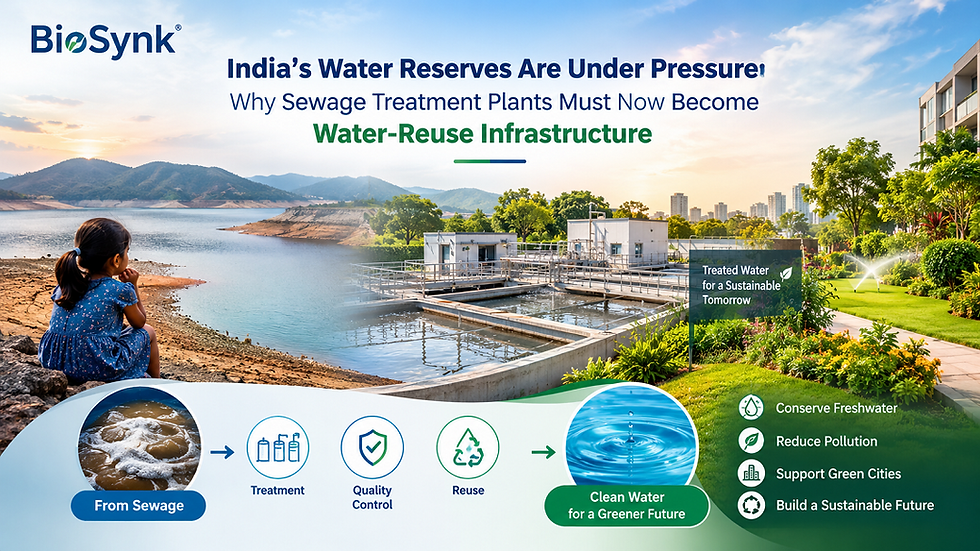
Wastewater Treatment Should Move Towards Water Reuse
One of the biggest opportunities for India is to stop viewing treated wastewater as waste.
Properly treated wastewater can potentially be reused for suitable non-potable applications depending on quality requirements and applicable regulations.
Examples include:
Landscape irrigation
Gardening
Toilet flushing
Road washing
Vehicle washing
Cooling applications
Other approved non-potable uses
This can reduce dependence on freshwater resources.
For water-stressed cities, this approach can be particularly valuable.
Instead of:
Freshwater → Use → Wastewater → Discharge
cities can increasingly move towards:
Freshwater → Use → Treatment → Reuse
This creates a more circular approach to water management.
Why Reliable STP Technology Matters for Apartments and Buildings
Large residential communities, apartments, hotels, hospitals, schools, colleges and commercial buildings generate wastewater every day.
For these facilities, an STP is not an optional environmental feature. It becomes an important part of responsible water management.
A reliable STP should ideally provide:
Consistent treatment + manageable operation + efficient maintenance + safe reuse
The plant should also be designed according to the actual wastewater-generation profile of the property rather than simply choosing a standard system without proper assessment.
Underground STPs Can Help Optimise Space
Land availability is another major challenge in urban India.
Apartments, hospitals, commercial developments and institutions often have limited open space for wastewater infrastructure.
Underground RCC STP systems can provide an option where the treatment infrastructure is integrated below ground while the surface area can remain available for other uses, subject to engineering and site requirements.
This can be particularly useful for:
Apartment communities
Villas
Hotels
Hospitals
Schools
Colleges
Commercial buildings
Large residential developments
The objective should be to integrate wastewater treatment into the project rather than allowing the treatment plant to become an obstacle to efficient land use.
The Bigger Lesson From Delhi
The latest Delhi findings provide an important lesson for cities across India.
Wastewater treatment does not end when an STP is installed.
The real measure of success is whether the system continues to treat wastewater effectively over time.
Regular monitoring, preventive maintenance, proper loading, trained operation and appropriate technology all play an important role in maintaining treatment performance.
The Delhi findings also reinforce why environmental compliance cannot be treated as a one-time exercise.
Continuous performance matters.
India Needs a Stronger Wastewater Management Culture
India's urban population is growing, and water demand is increasing.
At the same time, freshwater resources are under increasing pressure.
This makes wastewater treatment and reuse an essential part of sustainable urban development.
Cities need to focus on three connected areas:
Treat
Wastewater must receive appropriate treatment before discharge or reuse.
Monitor
Treatment performance needs regular testing and monitoring against applicable standards.
Reuse
Where technically and legally appropriate, treated wastewater should be reused for non-potable applications rather than unnecessarily consuming freshwater.
This approach can help reduce pollution while improving water security.
Conclusion
The finding that nearly eight Delhi STPs failed to meet prescribed discharge standards is an important reminder that wastewater treatment must focus on performance, not simply infrastructure.
A sewage treatment plant should be designed, installed, operated and maintained with one central objective: consistently producing appropriately treated wastewater that can be safely discharged or reused according to applicable requirements.
As Indian cities continue to expand, reliable wastewater treatment will become increasingly important for protecting rivers, conserving freshwater and building sustainable communities.
The future of urban water management is not simply about treating sewage.
It is about treating wastewater effectively, monitoring quality continuously and turning treated water into a valuable resource wherever appropriate.
Looking for a Reliable Sewage Treatment Plant?
If you are planning an STP for an apartment, villa, commercial building, hospital, school, hotel, industrial facility or other project, choosing the right treatment solution is critical for long-term performance.
Explore Bio Synk Sewage Treatment Plant solutions: Sewage Treatment Plant – Bio Synk
Source: The New Indian Express, reporting on the latest DPCC findings published August 20, 2026.


Comments