
India’s Water Reserves Are Under Pressure: Why Sewage Treatment Plants Must Now Become Water-Reuse Infrastructure

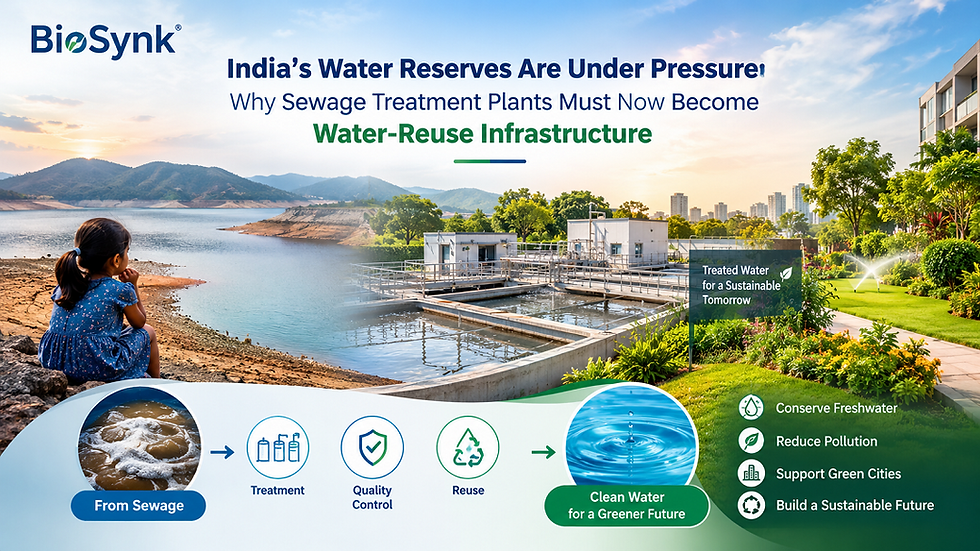
India’s water conversation is changing.
For many years, a sewage treatment plant was primarily viewed as an environmental compliance system: collect sewage, treat it, meet discharge standards and release the treated water safely.
That approach is no longer enough.
As cities expand, industries consume more water and freshwater resources come under increasing pressure, wastewater is becoming an important secondary water resource. The question is shifting from “How do we dispose of sewage safely?” to “How can we treat, recover and responsibly reuse the water already available in our cities and facilities?”
This change is particularly important in 2026.
Recent water-storage data has highlighted the pressure on India’s water resources. As of late September 2026, storage in major reservoirs was reported at about 70% of total capacity, below the decadal average, with South India experiencing especially low storage levels. This does not mean every city or facility faces the same water shortage, but it reinforces a broader infrastructure lesson: freshwater cannot be treated as an unlimited input.
At the same time, government programmes and water-sector institutions are placing greater emphasis on the safe reuse of treated wastewater.
This creates a new opportunity for the modern Sewage Treatment Plant.
Instead of being the final step before discharge, an STP can become an important part of a facility’s water-recycling strategy.
The Old STP Model Is No Longer the Whole Story
A conventional wastewater-management model is relatively straightforward:
Freshwater → Use → Sewage → Treatment → Discharge
The newer circular approach is different:
Freshwater → Use → Sewage → Treatment → Quality Control → Reuse → Reduced Freshwater Demand
This distinction is important for apartments, hospitals, hotels, educational campuses, industrial facilities, commercial developments, data centres and large institutions.
If treated wastewater can safely replace freshwater for suitable non-potable applications, the same volume of water can potentially serve more than one purpose before leaving the site or entering the wider water system.
Possible applications can include:
Toilet flushing
Landscape irrigation
Gardening
Road and floor washing
Cooling-related applications where appropriate
Construction activities
Industrial utilities
Agricultural applications where permitted and suitably treated
Other non-potable uses based on water-quality requirements
The objective is not to use treated sewage indiscriminately.
The objective is to match water quality with the intended application.
That principle is becoming increasingly important in wastewater planning.
Why Water Reuse Is Becoming More Important in 2026
India’s urban population continues to grow, while cities require reliable water supplies for homes, businesses, institutions and industries.
At the same time, sewage generation increases with water consumption.
This creates a paradox.
A city can experience water stress while producing millions of litres of wastewater every day.
The problem is therefore not always simply a lack of water.
It is also a question of where the water is, what condition it is in, how it is treated and whether it can safely be reused.
The Central Pollution Control Board’s guidance on treated wastewater reuse recognizes this concept by describing treated sewage as a potential resource for non-potable and industrial applications. The guidance also emphasizes that the required quality depends on the intended end use.
This is a critical engineering principle.
A wastewater system should not be designed simply around the phrase “clean water.”
It should be designed around:
Source → Treatment → Required Quality → End Use → Monitoring
That is where modern sewage treatment planning becomes more strategic.
A Sewage Treatment Plant Should Be Designed Around the Final Water Destination
One of the most important questions before selecting an STP technology is:
What will happen to the treated water?
If the answer is simply “discharge,” the design discussion may focus mainly on meeting applicable discharge requirements.
If the answer is “reuse,” the design needs to go further.
The treatment process, polishing requirements, disinfection, storage, monitoring and distribution system may all need to be considered according to the proposed application.
For example, water intended for toilet flushing has different requirements from water intended for industrial process use.
Similarly, water intended for landscaping may require a different treatment and monitoring approach from water intended for a sensitive industrial application.
Therefore, an effective wastewater project should begin with a water-reuse plan, rather than treating reuse as an afterthought.
The Hidden Value of Decentralized Wastewater Treatment
Large centralized sewage infrastructure has an important role in cities.
However, decentralization can also provide useful advantages where wastewater is generated far from a centralized network or where connecting a facility to a large sewer system is impractical.
A decentralized wastewater treatment system can treat sewage closer to its point of generation.
This can be particularly relevant for:
Large residential developments
Hospitals
Hotels and resorts
Schools and colleges
Industrial campuses
Remote facilities
Institutional buildings
Infrastructure projects
Commercial developments
The basic idea is simple:
Treat wastewater where it is generated and reuse it where it is needed.
This can reduce dependence on freshwater for applications that do not require potable-quality water.
It can also reduce the need to transport untreated or partially treated wastewater over long distances.
Why Biological Treatment Deserves More Attention
Wastewater contains a complex mixture of organic matter, suspended solids, nutrients and microorganisms.
Biological treatment uses naturally occurring microbial processes to break down biodegradable organic pollutants.
This is fundamentally different from thinking of wastewater treatment as simply a chemical-cleaning process.
In biological systems, microorganisms become part of the treatment mechanism.
Depending on the technology and treatment objective, different biological processes may be used to reduce organic pollutants and improve water quality.
For facility owners, however, technology should not be selected merely because it sounds advanced.
The more important questions are:
What is the incoming sewage quality?
What is the daily flow?
What peak flow can occur?
What treatment quality is required?
Where will the treated water be reused?
What monitoring is required?
How much operator involvement is realistic?
What are the lifecycle operating requirements?
How will sludge and other residuals be managed?
What happens during low-flow and high-flow conditions?
A technically impressive STP can still perform poorly if it is badly matched to the actual project.
The Real Challenge: Designing for Operation, Not Just Installation
One of the most overlooked aspects of a sewage treatment plant is what happens after commissioning.
An STP is not successful merely because the equipment has been installed.
It must continue to deliver the required treatment performance under real operating conditions.
That means project planning should consider:
1. Flow variation
Sewage generation rarely remains constant throughout the day.
Residential buildings, hospitals, hotels and industrial facilities can have different peak-flow patterns.
2. Inlet characteristics
Domestic sewage and industrial wastewater are not interchangeable.
Where industrial wastewater contains significant process contaminants, an appropriate effluent-treatment strategy may be required in addition to sewage treatment.
3. Treatment objectives
The required treatment quality depends on whether the water will be discharged or reused.
4. Maintenance requirements
Pumps, blowers, mechanical systems, electrical systems and other components can affect operating costs and maintenance requirements.
5. Monitoring
Water quality should be monitored according to the applicable requirements and intended reuse application.
6. Residual management
A responsible wastewater strategy must also address sludge and other treatment residuals.
This is why selecting an STP should be a lifecycle decision rather than simply a capital-cost decision.
Chennai and Tamil Nadu Offer an Important Example
Tamil Nadu has been discussing treated wastewater reuse for several years.
The state's wastewater reuse policy aims to increase sewage collection and treatment while encouraging treated wastewater as an economic resource and reducing dependence on freshwater.
Government information also documents reuse arrangements involving agriculture and industrial applications in several locations across Tamil Nadu.
This is significant because it demonstrates a practical shift:
Wastewater does not necessarily have to be treated as waste.
With appropriate treatment, quality control and end-use planning, it can become part of a broader water-management system.
For Chennai and other rapidly developing urban areas, this concept has particular relevance.
Instead of treating every litre of used water as something that must immediately leave the system, cities and large facilities can increasingly ask whether a portion of that water can be safely recovered and reused.
The Industrial Opportunity Is Even Larger
Industries often require significant volumes of water for manufacturing, cleaning, cooling and other utility functions.
At the same time, wastewater management is becoming increasingly important for environmental compliance and resource efficiency.
An industrial water strategy can therefore combine several systems:
Freshwater Supply + Process Water Management + ETP/STP + Tertiary Treatment + Reuse + Monitoring
For facilities generating both domestic sewage and industrial effluent, it is essential to distinguish between the two streams.
A sewage treatment plant is designed primarily for sewage.
An industrial effluent treatment plant is designed around the specific characteristics of industrial wastewater.
In some projects, both systems may form part of a larger integrated water-management strategy.
The final objective is to reduce freshwater dependence while ensuring that every reuse application is technically and environmentally appropriate.
What Should Businesses Ask Before Buying an STP?
Instead of asking only:
“How much does a Sewage Treatment Plant cost?”
project owners should ask a broader set of questions.
What is our actual daily sewage generation?
Designing from an assumed population without understanding actual water consumption and peak conditions can create problems.
What is our reuse target?
If treated water is going to be reused for flushing, gardening or industrial applications, that should be incorporated into the design from the beginning.
What quality is required at the point of reuse?
The treatment target should be connected to the actual end use.
What is the expected operating model?
A facility should understand who will inspect, monitor and maintain the system.
What is the lifecycle cost?
Capital expenditure is only one part of wastewater economics.
Electricity, chemicals where applicable, manpower, maintenance, replacement components, sludge handling and testing can influence the long-term cost.
Can the system fit the site?
For urban projects, land availability can be a major constraint.
Underground or compact approaches may be considered where technically appropriate and permitted.
What happens to the treated water?
This question should be answered before construction, not after commissioning.
Why “Reuse First” Is Becoming a Better Design Philosophy
A wastewater project designed around discharge asks:
How do we meet the required treatment standard?
A water-reuse project asks:
How do we safely recover the maximum useful value from this wastewater?
These are related but different approaches.
The second approach encourages designers and facility owners to consider the complete water cycle.
For example:
1. Freshwater enters the facility.
↓
2. Water is used for domestic, commercial or industrial purposes.
↓
3. Wastewater is collected separately and appropriately.
↓
4. The Sewage Treatment Plant treats the wastewater.
↓
5. Treated water is tested against the intended application.
↓
6. Suitable water is reused for approved non-potable purposes.
↓
7. Freshwater demand is reduced.
This is the practical foundation of a circular water economy.
STP Technology Should Become More Site-Specific
There is no universal wastewater solution that is automatically correct for every building.
A 50-room hotel, a 500-bed hospital, a residential community, a school campus and a large industrial estate can have completely different wastewater characteristics and operating patterns.
Therefore, STP selection should consider:
Population or occupancy
Water consumption
Sewage generation
Peak flow
Available land
Inlet characteristics
Required treated-water quality
Reuse application
Local regulatory requirements
Power availability
Maintenance capabilities
Sludge-management strategy
Future expansion
This site-specific approach is more useful than selecting an STP purely from a catalogue capacity.
The Future of Wastewater Is Not Just Treatment
The wastewater sector is moving toward a broader concept:
Treat → Recover → Recycle → Reuse
That means the value of a sewage treatment plant should not be measured only by how much sewage it treats.
It should also be considered in terms of:
Freshwater saved
Treated water reused
Pollution prevented
Operational reliability
Resource recovery
Energy consumption
Lifecycle maintenance
Environmental performance
Recent national initiatives around safe reuse of treated wastewater show that this transition is already becoming part of water-management planning.
The Ministry of Jal Shakti has highlighted treated wastewater reuse in the context of river rejuvenation and city-level reuse planning, while city-level studies are increasingly examining specific applications for treated water.
This suggests an important direction for future infrastructure:
Wastewater treatment and water supply should no longer be planned as completely separate subjects.
They are two parts of the same water cycle.
Where BioSynk Fits Into This Changing Water Strategy
At BioSynk, the focus is on biological wastewater treatment systems designed around practical wastewater management and reuse requirements.
BioSynk’s Bio STP solutions are developed for applications including commercial facilities, institutions, hospitals, residential developments and industrial projects.
The approach emphasizes biological treatment, practical operation and integration of treated-water reuse into the overall wastewater strategy.
For suitable projects, BioSynk systems can be considered for applications where treated wastewater is intended for uses such as toilet flushing, gardening and other appropriate non-potable purposes, subject to project-specific treatment requirements and applicable standards.
For larger projects, the engineering approach should begin with the actual wastewater flow, site conditions, treatment objectives and reuse destination.
The goal is not simply to install another treatment unit.
The goal is to build a wastewater system that supports a more sustainable water cycle.
Conclusion: Every Drop of Wastewater Is a Potential Water Resource
India’s water challenge is not going to be solved by one technology.
It requires better water conservation, improved infrastructure, responsible consumption, stronger wastewater treatment, effective monitoring and greater reuse of treated water.
The role of the Sewage Treatment Plant is therefore changing.
It is no longer enough to think of an STP as a machine that treats sewage before discharge.
A properly planned STP can become part of a larger strategy to:
Treat wastewater. Recover water. Reduce freshwater demand. Protect water bodies. Reuse resources.
As water availability becomes more variable and demand continues to rise, the most valuable wastewater may be the wastewater that is safely treated and reused rather than simply discharged.
For businesses, institutions, industries and urban developments, this is the time to stop viewing wastewater as the end of the water cycle.
It can be the beginning of the next one.
Need a Sewage Treatment Plant Designed for Your Project?
BioSynk provides biological wastewater treatment solutions for commercial, institutional, residential, hospital and industrial applications.
Explore the BioSynk Sewage Treatment Plant solution and discuss your project requirements, capacity, site conditions and treated-water reuse objectives with the technical team:
BIOSYNK (INDIA) PRIVATE LIMITED
Treat Wastewater at Source. Reuse Water at Source.


Comments