
Gurugram to Reuse 27 MLD Treated Wastewater for Green Belts and Ponds: Why India Must Embrace Water Reuse


India's cities are facing a growing challenge: how to meet rising water demand without putting even more pressure on freshwater resources.
A major step toward solving this challenge is taking place in Gurugram, Haryana, where nearly 27 million litres per day (MLD) of treated wastewater from the Behrampur Sewage Treatment Plant (STP) will be reused for horticulture, green spaces and replenishing ponds in Bhondsi and surrounding areas.
The development is an important example of how sewage treatment can move beyond simply treating wastewater for discharge. Instead, properly treated wastewater can become a valuable resource for suitable non-potable applications.
Gurugram Plans to Reuse 27 MLD of Treated Wastewater
According to a report published on August 21, 2026, three pipelines have been developed to divert treated wastewater from the Behrampur STP toward the Police Training Centre at Bhondsi, Gairatpur Bass and Tikli.
The planned distribution includes:
18 MLD for the Police Training Centre at Bhondsi
4 MLD for Gairatpur Bass
5 MLD for Tikli
Together, these pipelines are expected to facilitate the reuse of approximately 27 MLD of treated wastewater.
The water will be used for maintaining green areas, horticultural activities and filling ponds instead of using potable freshwater for these purposes.
This is a significant shift in the way urban wastewater can be managed.
Why Is This Important?
For decades, wastewater was largely considered something that needed to be collected, treated and discharged.
But growing cities are changing that approach.
Today, wastewater can be viewed as a potential secondary water resource when it receives appropriate treatment and meets the quality requirements for its intended use.
Gurugram's initiative demonstrates this principle in practice.
Instead of using freshwater to maintain large green spaces or replenish ponds, treated wastewater can be directed toward these applications.
This can help reduce unnecessary freshwater consumption while giving treated wastewater a productive purpose.
Gurugram Already Generates 243 MLD of Tertiary-Treated Water
The scale of Gurugram's wastewater infrastructure makes the initiative particularly significant.
The city currently generates approximately 243 MLD of tertiary-treated water from its sewage treatment plants.
Of this quantity, around 202 MLD is already being used for irrigation, industrial applications, groundwater recharge, parks, green belts and water bodies.
The new 27 MLD reuse initiative therefore builds on an existing wastewater-reuse system rather than treating reuse as a completely new concept.
It shows how cities can gradually increase the productive use of treated wastewater.
Treated Wastewater Can Reduce Freshwater Demand
Freshwater is a valuable resource.
Using drinking-quality or potable water for applications such as gardening, landscaping and pond maintenance can create unnecessary pressure on freshwater supplies.
For many non-potable applications, appropriately treated wastewater can provide an alternative, subject to applicable standards and site-specific requirements.
Potential applications include:
Gardening and Landscaping
Large apartment communities, hotels, institutions, hospitals, campuses and public facilities can require substantial quantities of water to maintain landscaping.
Using appropriately treated wastewater for irrigation can reduce dependence on freshwater.
Green Belts and Parks
Urban green spaces require regular irrigation, particularly during dry periods.
Recycled water can potentially support these areas while reducing demand on conventional water supplies.
Pond Replenishment
Gurugram's project will use treated wastewater to replenish ponds in Gairatpur Bass and Tikli.
However, pond and environmental reuse requires careful water-quality monitoring and appropriate treatment to ensure that the receiving environment is protected.
Industrial Applications
Treated wastewater can also support certain industrial applications where the required water quality can be achieved and reuse is permitted.
This can help industries reduce their freshwater footprint.
Water Quality Monitoring Is Critical
One of the most important aspects of Gurugram's project is that the treated water will be checked for quality before being put to use.
Haryana State Pollution Control Board officials have been directed to collect samples and verify that the treated wastewater meets prescribed standards. Regular quality checks are also planned.
This is an important lesson for every wastewater-reuse project.
Wastewater reuse should never mean using untreated sewage.
The wastewater must undergo appropriate treatment, and the final water quality should be monitored according to its intended application and applicable requirements.
A successful water-reuse strategy therefore requires three essential elements:
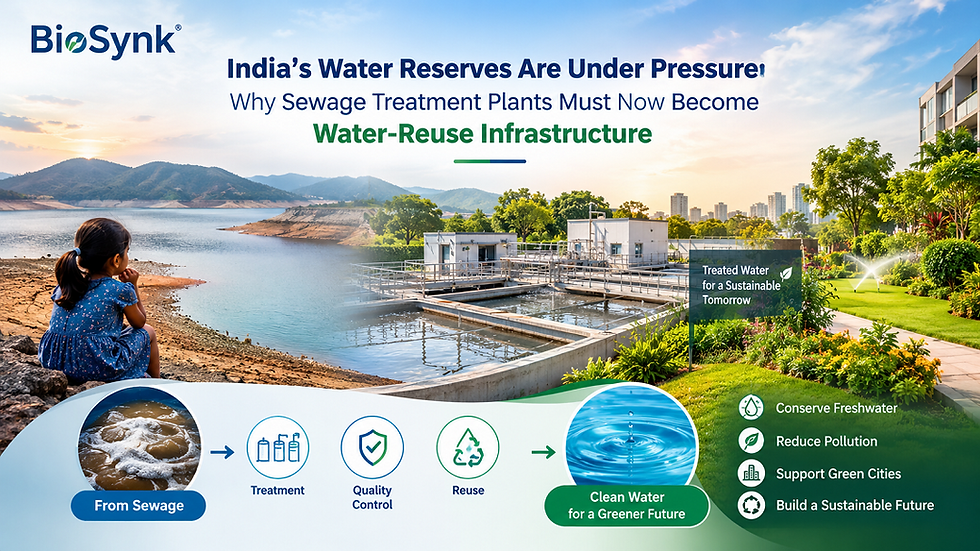
Treatment → Testing → Reuse
Why STP Performance Matters
Installing an STP is only the first step.
The plant must continue to perform effectively throughout its operating life.
Treatment performance can depend on several factors, including:
Correct plant sizing
Wastewater characteristics
Hydraulic loading
Organic loading
Appropriate treatment technology
Proper operation
Preventive maintenance
Monitoring and testing
Sludge management
Final treated-water quality
If an STP is poorly operated or overloaded, the quality of treated water can deteriorate.
Therefore, wastewater reuse must always be supported by a properly designed and maintained treatment system.
From Sewage Treatment to Water Resource Management
The Gurugram initiative represents a broader change in thinking.
An STP should not be viewed simply as a pollution-control facility.
It can also become part of a circular water management system.
The traditional model looks like this:
Freshwater → Consumption → Wastewater → Treatment → Discharge
A more sustainable model can be:
Freshwater → Consumption → Wastewater → STP → Treated Water → Reuse
This approach can reduce freshwater demand and potentially reduce the amount of treated wastewater that needs to be discharged.
What This Means for Apartments and Commercial Buildings
Large residential and commercial developments generate significant quantities of wastewater every day.
Apartments, gated communities, hospitals, hotels, schools, colleges and commercial buildings can consider wastewater reuse as part of their overall water-management strategy.
For example, treated wastewater may be considered for suitable non-potable applications such as:
Gardening
Landscape irrigation
Toilet flushing
Vehicle washing
Road cleaning
Cooling applications
Other permitted non-potable uses
The exact reuse application should depend on the quality of treated water, treatment level, local requirements and applicable regulations.
Underground STPs Can Support Space-Constrained Projects
Urban developments often face another challenge: limited land availability.
A conventional wastewater-treatment plant can require significant space, which can be difficult to accommodate in modern apartment communities and commercial projects.
Underground RCC STP systems can help integrate wastewater treatment into developments where site conditions and engineering requirements allow.
With an underground configuration, the treatment infrastructure can be placed below ground while the surface area can potentially remain available for landscaping, parking or other project requirements.
This makes underground wastewater treatment particularly relevant for:
Apartments
Villas
Gated communities
Hospitals
Hotels
Schools
Colleges
Commercial buildings
Why Water Reuse Will Become More Important in Indian Cities
India's cities are expanding rapidly.
More residents mean greater water consumption.
Greater water consumption means greater wastewater generation.
Instead of treating this wastewater as something that must simply be disposed of, cities can increasingly look at it as part of their water-resource strategy.
Gurugram's latest initiative demonstrates this approach clearly.
Nearly 27 MLD of treated wastewater will be redirected toward productive uses, while the city's existing reuse network already puts approximately 202 MLD of treated water to work.
This type of approach can become increasingly important as cities experience water stress.
The Future: Treat, Recycle and Reuse
The future of urban water management will not be based only on building more water-supply infrastructure.
It will also depend on managing wastewater more intelligently.
A sustainable city needs to ask:
How much wastewater are we generating?
How much are we treating?
How much treated water are we reusing?
How much freshwater can we save through recycling?
These questions can help cities move from a linear water system toward a more circular model.
Gurugram's 27 MLD Initiative Is a Sign of Change
The decision to reuse nearly 27 MLD of treated wastewater from Behrampur STP is more than a local infrastructure project.
It represents an important principle for India's future:
Wastewater should not always be treated as waste.
When properly treated, monitored and used for appropriate purposes, wastewater can become a valuable resource.
Gurugram's plan to use treated water for green belts, horticulture and ponds demonstrates how wastewater treatment and water conservation can work together.
As India's cities continue to grow, more projects like this could help reduce pressure on freshwater resources while supporting greener and more sustainable urban development.
Conclusion
The reuse of nearly 27 MLD of treated wastewater from Gurugram's Behrampur STP is a strong example of India's growing focus on wastewater recycling and water conservation.
Instead of using freshwater for every urban requirement, cities can increasingly use appropriately treated wastewater for suitable non-potable purposes.
But successful reuse depends on effective sewage treatment, regular quality monitoring, proper infrastructure and responsible operation.
The message for India's cities is clear:
Treat wastewater. Test its quality. Reuse it responsibly. Save freshwater.
Looking for a Reliable Sewage Treatment Plant?
If you are planning an STP for an apartment, villa, hospital, hotel, school, commercial building, industrial facility or other project, choosing the right treatment solution is essential for long-term wastewater management and water reuse.
Explore Bio Synk Sewage Treatment Plant solutions:
Source: Times of India, August 21, 2026, reporting on Gurugram's plan to reuse treated wastewater from the Behrampur STP.


Comments