
Bhubaneswar Commissions New STPs: Why Decentralised Wastewater Treatment Is the Future of Sustainable Cities


Bhubaneswar has taken another important step towards better urban sanitation and water conservation with the commissioning of two new Sewage Treatment Plants (STPs) at public toilet complexes near Bhubaneswar Railway Station and Jayadev Vihar.
The new treatment facilities are designed to treat wastewater generated from these public toilet facilities. According to reports, each plant has a treatment capacity of 40 KLD (kilolitres per day). After treatment and disinfection, the recovered water will be used for horticulture and other approved non-potable purposes.
More importantly, these two plants are part of a broader plan by the Bhubaneswar Municipal Corporation (BMC) to introduce decentralised wastewater treatment and recycling systems at 30 public toilets across the city.
This development represents more than just the installation of two sewage treatment plants. It demonstrates an important shift in how growing Indian cities can manage wastewater:
Treat wastewater closer to where it is generated, reuse the treated water, and reduce pressure on freshwater resources and central sewage infrastructure.
What Is Decentralised Wastewater Treatment?
Traditional wastewater management often depends on a centralised system.
In a centralised model, sewage from homes, commercial buildings, institutions and other locations is collected through extensive underground sewer networks and transported to a large STP located some distance away.
This model can work effectively in areas with established sewer networks and sufficient infrastructure.
However, rapidly growing cities often face challenges such as:
Expanding urban areas
Limited sewer connectivity
High infrastructure costs
Long-distance sewage transportation
Pumping requirements
Difficult terrain
Increasing wastewater generation
Lack of treatment facilities in newly developed areas
A decentralised wastewater treatment system takes a different approach.
Instead of transporting all wastewater over long distances, wastewater can be treated near its source of generation.
For example, a public toilet complex, apartment community, hotel, school, hospital, office campus or other institution can have an appropriately designed wastewater treatment system within or close to the premises.
The Bhubaneswar initiative is an example of this approach being applied at the city level.
Why Bhubaneswar's New STPs Matter
At first glance, treating wastewater from public toilets may appear to be a small infrastructure project.
But the principle behind the project is significant.
Every public facility generates wastewater.
If that wastewater is collected and transported without proper treatment, it ultimately adds to the burden on the city's drainage and sewage infrastructure.
A decentralised STP can provide treatment closer to the point where wastewater is generated.
This can help cities move towards a more distributed wastewater-management network.
Instead of thinking only about:
One city → One large treatment system
urban planners can increasingly consider:
City → Zones → Communities → Buildings → Local treatment and reuse
This does not mean centralised STPs are no longer necessary. Large centralised treatment plants will continue to play an important role in cities.
Rather, decentralised systems can complement central infrastructure where local treatment is technically and economically appropriate.
From Wastewater to Reusable Water
One of the most important aspects of the Bhubaneswar project is not simply wastewater treatment.
It is water reuse.
The treated wastewater from the new STPs will undergo disinfection and be used for horticulture and other approved non-potable applications.
This is an important concept for water-stressed cities.
Consider the traditional water cycle:
Freshwater → Use → Wastewater → Disposal
A more sustainable approach is:
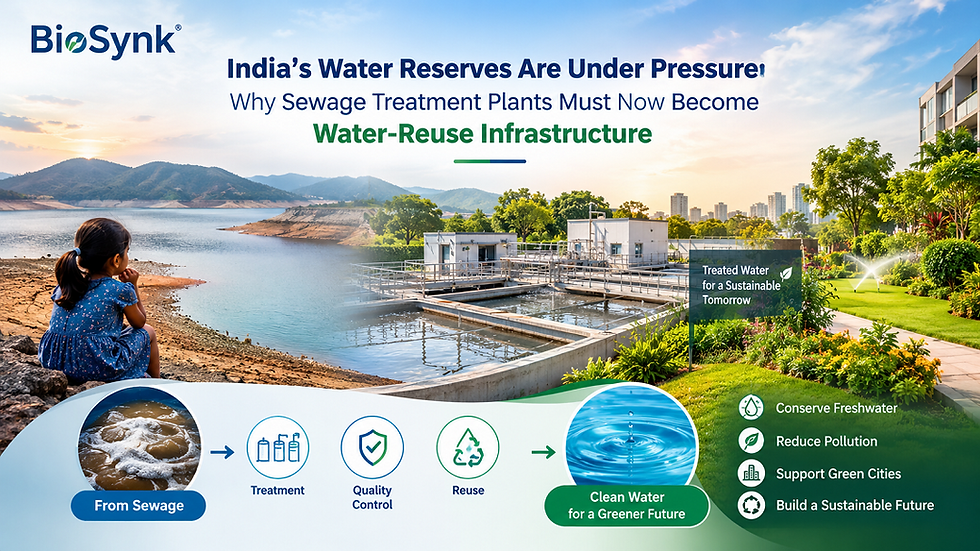
Freshwater → Use → Treatment → Reuse → Reduced Freshwater Demand
Water used for suitable non-potable purposes does not always need to be drinking-quality freshwater.
For applications such as landscaping and gardening, properly treated and disinfected wastewater can potentially provide an alternative water source, subject to applicable standards and approvals.
This can reduce the demand for freshwater for applications that do not require potable water.
Why Water Reuse Is Becoming More Important
India's cities are expanding rapidly.
As populations grow and commercial and residential development increases, water demand also increases.
At the same time, every additional person, building and commercial facility generates wastewater.
This creates a fundamental urban challenge:
More water consumption means more wastewater generation.
If cities continue to use freshwater once and then dispose of the resulting wastewater, valuable water resources are lost.
Wastewater treatment and reuse can help change that model.
Instead of treating sewage only as something that must be disposed of, cities can increasingly view wastewater as a resource that requires treatment and responsible reuse.
The Bhubaneswar project demonstrates this principle at a local level.
Why Decentralised STPs Can Benefit Growing Cities
Decentralised wastewater treatment can offer several potential advantages when properly planned and designed.
1. Treatment Near the Source
Wastewater can be treated close to where it is generated.
This can reduce the need to transport relatively small wastewater flows over long distances.
2. Reduced Pressure on Central Sewer Networks
Where local treatment is appropriate, decentralised systems can reduce the amount of wastewater that needs to travel through a large central sewer network.
This can be particularly useful in locations where sewer connectivity is limited or still developing.
3. Water Reuse at the Same Location
One of the biggest advantages is the possibility of reusing treated water locally.
For example:
Public toilet → STP → Treated water → Gardening
This creates a short and practical water-reuse cycle.
4. Suitable for Different Types of Developments
Decentralised treatment concepts can be considered for:
Apartments
Villas
Gated communities
Hotels
Hospitals
Schools
Colleges
Offices
Commercial complexes
Public facilities
Institutional campuses
Industrial facilities
The actual treatment technology and capacity must be selected according to wastewater quantity, characteristics, site conditions and applicable requirements.
5. Supports Water Conservation
When treated wastewater is reused for suitable non-potable applications, freshwater consumption can potentially be reduced.
This is particularly important for cities facing increasing water demand.
Decentralised Does Not Mean Smaller Standards
An important point should not be overlooked.
A decentralised STP should not mean a lower standard of wastewater treatment.
Whether the treatment plant is large or small, the system should be properly designed, installed, operated and maintained.
A good wastewater treatment system should consider:
Wastewater flow
Peak flow
Organic loading
BOD
COD
Suspended solids
pH
Site conditions
Required treated-water quality
Intended reuse application
Disinfection requirements
Sludge management
Applicable regulatory requirements
The treatment process should be selected based on the actual application rather than simply choosing a technology because it is compact or inexpensive.
The Importance of Proper STP Design
Installing an STP is only one part of wastewater management.
The plant must also be designed according to the expected wastewater generation.
For example, an apartment complex generating 100 KLD of sewage should not simply select a treatment system based on available space.
The design should consider:
Actual wastewater generation + peak flow + treatment requirements + future requirements + reuse objective.
Similarly, a hospital, hotel or commercial facility may have different wastewater characteristics and operational requirements.
Therefore, professional wastewater assessment and engineering are important before finalising the treatment system.
What Happens Inside an STP?
Although treatment technologies vary, sewage treatment generally involves several stages.
Preliminary Treatment
Large floating materials, plastics, rags and other coarse solids are removed during the initial stage.
Primary Treatment
Suspended solids and settleable material can be separated through physical processes.
Biological Treatment
Microorganisms help break down biodegradable organic matter present in sewage.
This is one of the most important stages of biological sewage treatment.
Secondary Clarification
Biological solids can be separated from the treated wastewater.
Tertiary Treatment
Depending on the required treated-water quality and reuse application, additional treatment may be provided.
Disinfection
Disinfection helps control harmful microorganisms before treated water is reused or discharged as permitted.
The exact treatment train should be selected according to the project requirements.
Why Public Toilets Are a Good Example
Public toilets demonstrate why decentralised treatment can make practical sense.
A public toilet generates wastewater at a specific location.
Instead of allowing that wastewater to become an additional burden on the surrounding drainage system, a local treatment system can process it.
The Bhubaneswar initiative takes this concept further by connecting treatment with water reuse for horticulture and other approved non-potable applications.
This creates a simple circular model:
Toilet Use → Wastewater → STP → Treatment → Disinfection → Reuse
The same principle can be applied to many other types of buildings and developments.
Apartments Can Follow the Same Model
Large residential developments generate significant quantities of sewage every day.
Apartments and gated communities can therefore benefit from properly designed onsite sewage treatment systems.
Instead of treating sewage as a waste stream that simply needs disposal, residential developments can look at:
Sewage Treatment + Water Reuse + Resource Conservation
Treated wastewater can potentially be reused for suitable purposes such as:
Gardening
Landscaping
Toilet flushing
Road cleaning
Other approved non-potable applications
This can reduce dependence on freshwater for non-potable requirements.
For large residential developments, STP planning should also include adequate space, access for maintenance, electrical requirements, sludge management and long-term operation.
Commercial Buildings Also Need Better Wastewater Management
Shopping malls, hotels, office buildings, IT parks and other commercial developments generate wastewater continuously.
A properly designed STP can help these facilities manage sewage within their premises.
For commercial projects, water reuse can be particularly valuable because landscaping and toilet flushing may represent significant non-potable water requirements.
Instead of using freshwater for every application, treated wastewater can be considered for suitable reuse wherever regulations and treatment quality permit.
This creates both an environmental and resource-management advantage.
Hospitals and Institutions Require Special Attention
Hospitals, schools, colleges and institutional campuses also generate substantial wastewater.
However, wastewater characteristics can vary depending on the facility.
Hospitals may have additional wastewater-management considerations because of the nature of their operations.
Educational campuses may experience significant fluctuations depending on occupancy, working days and academic schedules.
Therefore, an STP for a hospital, school or college should be designed based on the actual wastewater profile and operating conditions.
The lesson from Bhubaneswar is that wastewater treatment should be brought closer to the point of generation wherever decentralised treatment is suitable.
Decentralised STPs and the Future of Smart Cities
The future of sustainable cities is not simply about building more roads, buildings and digital infrastructure.
A truly sustainable city must also manage:
Water
Wastewater
Solid waste
Energy
Air quality
Natural resources
Wastewater management should therefore become part of urban planning from the beginning.
New developments should ask:
Where will the wastewater go?
How will it be treated?
Can treated water be reused?
How will the system be operated and maintained?
These questions should be answered before a project becomes operational.
The Circular Water Economy
The Bhubaneswar initiative also connects with a larger concept known as the circular water economy.
The traditional model is linear:
Extract → Use → Discharge
The circular model is:
Extract → Use → Treat → Recover → Reuse
This approach aims to keep water resources in productive use for longer.
Wastewater can contain water that, after appropriate treatment, may be suitable for certain non-potable applications.
Therefore, the objective should not always be simply:
“How do we dispose of wastewater?”
Instead, cities should increasingly ask:
“How can we safely treat and reuse this water?”
What Other Indian Cities Can Learn From Bhubaneswar
Bhubaneswar's approach provides several lessons for other urban areas.
Start Treatment Where Wastewater Is Generated
Local treatment can be considered for facilities where connecting to a large central system is difficult or inefficient.
Build Reuse Into the Project
A treatment plant should ideally be planned together with a clear and permitted reuse strategy.
Design for Long-Term Operation
An STP is not successful simply because it is installed.
It needs proper operation, maintenance, monitoring and periodic servicing.
Consider Future Expansion
Cities and developments grow.
Treatment infrastructure should therefore be planned with realistic future requirements in mind.
Reduce Freshwater Dependency
Treated wastewater can potentially replace freshwater for suitable non-potable uses.
The Real Goal: Treat More, Waste Less
The commissioning of two new STPs in Bhubaneswar is a reminder that wastewater management is becoming an increasingly important part of urban sustainability.
The project is particularly notable because it combines three important ideas:
Local wastewater treatment.
Water recycling.
Freshwater conservation.
The larger plan to introduce decentralised wastewater treatment and recycling systems at 30 public toilets shows how these concepts can potentially be scaled across a city.
For India's rapidly growing cities, this approach deserves serious attention.
The future of wastewater management should not be based only on transporting sewage farther away.
It should focus on treating wastewater effectively, reusing water responsibly and protecting natural water resources.
Conclusion: Decentralised Wastewater Treatment Can Help Build Sustainable Cities
Bhubaneswar's commissioning of new STPs is a significant example of how wastewater treatment can be integrated into everyday urban infrastructure.
The two new plants are designed to treat wastewater from public toilet facilities, disinfect the treated water and enable reuse for horticulture and other approved non-potable applications.
The larger plan for decentralised treatment systems at 30 public toilets takes the idea even further.
For India, the message is clear:
Every drop of wastewater should be treated responsibly.
Every suitable opportunity for water reuse should be explored.
And every growing city should plan wastewater infrastructure alongside urban development.
From public toilets to apartments, hotels, hospitals, schools, commercial buildings and large communities, properly designed sewage treatment systems can play an important role in reducing pollution and conserving freshwater.
The sustainable city of the future will not only consume water.
It will treat it, reuse it and protect it.
Looking for a Reliable Sewage Treatment Plant?
If your apartment, commercial building, institution, hospital, hotel, industrial facility or development project requires a professionally designed Sewage Treatment Plant, Bio Synk provides wastewater treatment solutions designed around project requirements, capacity and intended water reuse.
Explore our Sewage Treatment Plant solutions to learn more about suitable STP systems for your project:
Treat wastewater today. Reuse water responsibly. Build a cleaner and more sustainable tomorrow.
News reference: The New Indian Express reported on 18 August 2026 that the Bhubaneswar Municipal Corporation commissioned two STPs at public toilet complexes near Bhubaneswar Railway Station and Jayadev Vihar, as part of a plan for decentralised wastewater treatment and recycling at 30 public toilets across the city.


Comments