
🌊 Every Drop We Waste Today Is a Crisis Tomorrow: Why a Sewage Treatment Plant Is No Longer Optional in 2026


Introduction: The Silent Water Emergency Beneath Our Cities
India is growing. Cities are expanding. Industries are multiplying. Residential complexes are rising higher every year. But beneath this visible growth lies an invisible crisis - wastewater.
Every apartment, hospital, factory, hotel, and office generates sewage daily. When this wastewater is not treated properly, it contaminates rivers, pollutes groundwater, spreads disease, and damages ecosystems. What we flush away does not disappear - it returns to us through polluted water, unhealthy soil, and rising environmental costs.
In 2026, installing a sewage treatment plant (STP) is not just about compliance. It is about responsibility, sustainability, and smart financial planning.
What Is a Sewage Treatment Plant?
A sewage treatment plant is a system designed to treat wastewater generated from residential, commercial, and industrial sources. Its purpose is simple yet powerful: convert polluted water into reusable or safely dischargeable water.
An STP removes:
Suspended solids
Organic matter
Harmful bacteria
Toxic contaminants
Odor-causing substances
The result?
Clean water that can be reused for flushing, gardening, landscaping, cooling towers, or safely released into the environment without harming nature.
Modern bio-based STPs go a step further by using natural biological processes instead of heavy chemicals - making them eco-friendly and cost-effective.
Why India Cannot Ignore Wastewater Anymore
India generates massive volumes of sewage every single day. Unfortunately, a significant portion of it is either untreated or partially treated. This creates serious problems:
Rivers becoming polluted
Groundwater contamination
Increase in waterborne diseases
Soil degradation
Rising municipal treatment costs
As freshwater sources shrink, wastewater recycling becomes essential. The future of water security depends not on new sources - but on treating and reusing the water we already have.
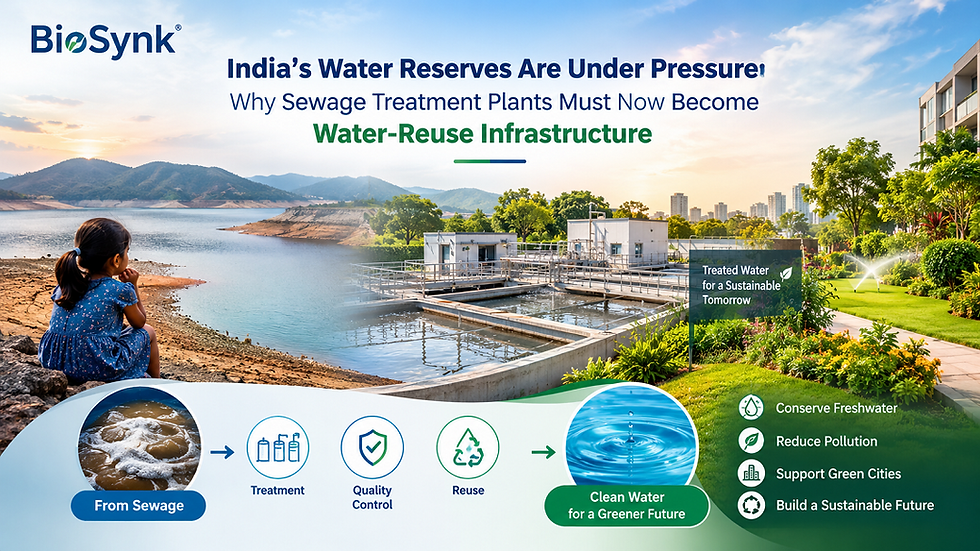
How a Modern Bio STP Works
Unlike traditional heavy mechanical systems, a modern bio sewage treatment plant works with nature.
Step 1: Primary Treatment
Large solids and debris are removed through screening and sedimentation.
Step 2: Biological Treatment
Beneficial microorganisms break down organic waste naturally. This is the heart of a bio STP - no harmful chemicals required.
Step 3: Filtration & Polishing
Water passes through advanced filtration systems to remove fine particles and impurities.
Step 4: Disinfection
Final treatment ensures harmful pathogens are eliminated.
The treated water is now suitable for reuse in non-drinking applications.
This process reduces environmental impact while lowering operational costs.
Where Sewage Treatment Plants Are Essential
Today, STPs are mandatory or strongly recommended for:
Apartment complexes
Gated communities
Hotels & resorts
Hospitals
Educational institutions
IT parks
Industrial facilities
Commercial buildings
If your property generates wastewater, installing a sewage treatment plant is not a luxury - it is a necessity.
The Financial Benefits of Installing an STP
Many property owners view STP installation as an expense. In reality, it is an investment.
1. Reduced Water Bills
Reusing treated water significantly reduces dependency on tanker water and municipal supply.
2. Lower Operational Costs
Modern bio STPs consume minimal electricity and require low maintenance.
3. Increased Property Value
Eco-friendly infrastructure enhances property appeal and long-term value.
4. Regulatory Compliance
Avoid penalties and legal complications by meeting pollution control norms.
5. Corporate Sustainability Image
Green initiatives strengthen brand credibility and ESG compliance.
Over time, the savings generated often outweigh the installation cost.
Environmental Impact: From Pollution to Preservation
Installing a sewage treatment plant means:
Cleaner rivers
Healthier groundwater
Reduced environmental damage
Lower carbon footprint
Sustainable urban growth
Wastewater, when treated correctly, becomes a resource instead of a liability.
The shift from disposal mindset to reuse mindset is the future of sustainable India.
Why Choose a Bio STP Over Conventional Systems?
Traditional STPs often require:
High electricity consumption
Constant monitoring
Sludge disposal management
Chemical usage
In contrast, a bio STP offers:
Low power consumption
Odor-free operation
Reduced sludge generation
Minimal maintenance
Compact design for urban spaces
It aligns with modern sustainability goals while ensuring consistent performance.
The Future Belongs to Water-Conscious Infrastructure
Cities of the future will not survive on freshwater extraction alone. They will survive on circular water systems - where wastewater is treated, reused, and reintegrated.
Builders, developers, industries, and institutions that act today will lead tomorrow.
Installing a sewage treatment plant is not just about meeting today’s requirements - it is about preparing for tomorrow’s water scarcity.
Why Choose Bio STP from Bio Synk?
At Bio Synk, we don’t just install sewage treatment plants - we design sustainable water ecosystems.
Our systems are:
Eco-friendly and bio-based
Custom-designed for your capacity
Space-efficient
Easy to maintain
Cost-effective in the long term
Compliant with pollution control norms
We provide end-to-end solutions - from design and installation to maintenance and support.
When you choose Bio Synk, you choose performance, sustainability, and long-term reliability.
Let’s Build a Cleaner, Water-Secure India - Together
Every drop treated is a drop saved.Every plant installed is pollution prevented.Every responsible decision builds a healthier future.
If your property generates wastewater, the time to act is now.
Install a modern sewage treatment plant.Reduce costs.
Protect the environment.Secure your future.


Comments