
Sewage Treatment Plant: The Heart of Sustainable Water Management in 2026


🌿 Introduction: Water Is Not Just a Resource _ It Is Our Lifeline
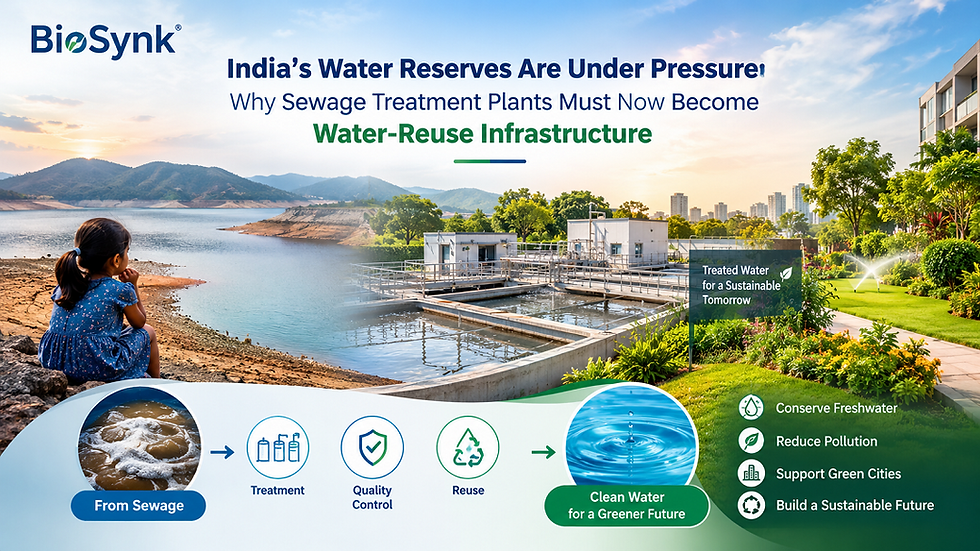
Water is the soul of every living ecosystem, the silent force behind every industry, school, hospital, home, and community. Yet in 2026, India stands at a critical point where our freshwater sources are shrinking while wastewater volumes are rapidly increasing. Rivers are polluted, groundwater levels are declining, and many cities have already crossed their safe environmental limits.In this moment, a Sewage Treatment Plant (STP) is no longer just an engineering solution _ it is the heart of sustainable development. A modern STP ensures that every drop we use returns to the ecosystem purified, safe, and reusable. This transformation of wastewater into a resource is the foundation of India’s environmental future.
1. What Is a Sewage Treatment Plant?
A Sewage Treatment Plant is a scientific system designed to purify wastewater from toilets, bathrooms, kitchens, factories, and institutions. It removes contaminants, harmful microorganisms, solids, toxins, and organic matter through biological, mechanical, and chemical processes.In today’s eco-conscious world, an STP is more than a treatment facility _ it is a sustainability engine. It reduces pollution, protects groundwater, improves sanitation, prevents ecosystem damage, and supports zero-liquid-discharge policies. Whether for residential apartments, industries, schools, hospitals, or commercial buildings, STPs have become a mandatory and essential part of modern infrastructure.
2. Why 2026 Is a Turning Point for Wastewater Management
India’s water demand has increased by nearly 60% in the last decade, but the availability of freshwater has reduced drastically. In 2026, environmental bodies, urban development authorities, and industrial regulators have intensified monitoring and compliance.At the same time, climate change has worsened droughts, irregular rainfall, and water scarcity. This has pushed every industry and community to adopt water recycling, rainwater recharge, and bio-based wastewater treatment systems.A Sewage Treatment Plant is now the backbone of sustainability _ not just for compliance but for survival.
3. The Growing Threat of Untreated Wastewater
Untreated sewage is one of India’s biggest environmental threats. Over 70% of urban sewage still flows directly into rivers, lakes, and soils without treatment. This leads to:
Dangerous contamination of drinking water sources
Spread of water-borne diseases
Death of aquatic ecosystems
Soil infertility
Reduced groundwater recharge
Increased environmental penalties on industries and institutions
A single STP can prevent millions of liters of wastewater from polluting nature every day. In 2026, this is no longer optional _ it is a civic responsibility.
4. What a Modern Sewage Treatment Plants Work
Modern STPs use advanced biological and bio-reactor technologies to purify wastewater in a highly efficient manner. These systems include:
Screening & Primary Treatment – Removes solids and floating waste
Biological Treatment (Bio STP) – Uses beneficial microbes to naturally digest waste
MBR / MBBR / SBR Technologies – High-efficiency reactors for maximum purification
Clarification & Filtration – Removes fine impurities
Disinfection (UV/Chlorine/Ozone) – Kills pathogens
Sludge Management – Converts waste into compost or biogas
This eco-friendly process returns clean, safe, reusable water suitable for gardening, toilet flushing, cooling towers, landscaping, construction, and more.
5. Why STPs Are Now Mandatory for Almost All Sectors in 2026
Government bodies such as CPCB, TNPCB, KSPCB, Pollution Control Boards across India, and Municipal Corporations have made STPs compulsory for:
Schools & colleges
Hospitals
Industries & industrial parks
Residential apartments
Commercial buildings
IT parks
Hotels & resorts
Layout approvals and government tenders
Without a compliant STP, institutions may face penalties, closure notices, or refusal of building approvals. In 2026, a Bio STP offers the easiest path to compliance, cost-saving, and environmental responsibility.
6. The Economic Advantage: STPs Help You Save Money
A well-designed STP drastically reduces the cost of freshwater usage. Industries and institutions using recycled water save lakhs of rupees every year.Additionally, modern Bio STPs consume less electricity, require fewer chemicals, and demand minimal operator support. This leads to massive long-term savings in operational costs.Beyond direct savings, avoiding environmental fines, legal issues, and damaged brand reputation makes an STP a financially wise investment.
7. Why Bio STP Technology Is the Future in 2026
Bio-based STPs use natural microorganisms to treat wastewater without chemicals. This reduces sludge, cuts energy use, and improves water quality.Bio STPs are widely used in:
Schools & colleges
Hospitals
Industrial clusters
Smart cities
Hotels & resorts
Apartments and gated communities
They are compact, odor-free, silent, and sustainable _ exactly what 2026 demands.
8. Why Choose Bio Synk for Sewage Treatment Plants
Bio Synk has established itself as a trusted name in India’s wastewater industry. Our STP systems are designed for efficiency, compliance, and sustainability.We provide:
Advanced Bio STP Technology
Low maintenance, low electricity systems
100% CPCB-compliant treated water
End-to-end turnkey installation
Compact designs suitable for any space
High durability and consistent performance
Expert support, AMC, and operator training
We don’t just install STPs _ we build long-term water solutions.
9. Let’s Build a Cleaner India, together
Every drop of water we save, every liter we recycle, and every STP we install becomes a contribution toward a greener, healthier India.In 2026, sustainability is not a trend it is a responsibility. Our rivers, our soil, our people, and our future generations deserve clean water and a pollution-free environment.A Sewage Treatment Plant is the heart of this mission. Let us join hands to build a nation where wastewater is no longer waste it is a resource of hope, renewal, and life.


Comments