
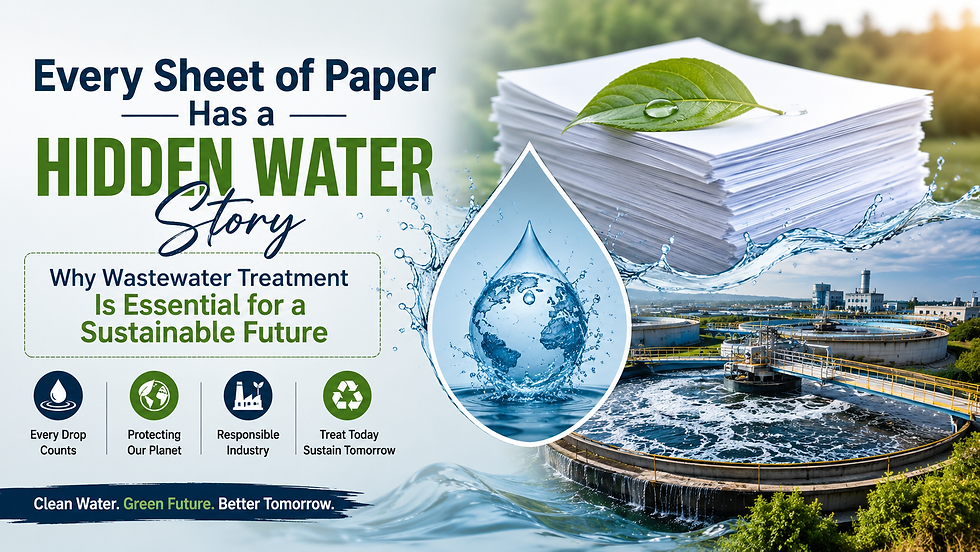
Every Sheet of Paper Has a Hidden Water Story: Why Wastewater Treatment Is Essential for a Sustainable Future

Introduction: The Water Behind Every Page We Use
Every day, billions of people interact with paper products without giving much thought to how they are made. From notebooks and newspapers to packaging boxes, tissues, books, and office documents, paper remains one of the most widely used materials in modern society.
Yet behind every sheet of paper lies an invisible resource that makes production possible: water.
Water is involved in nearly every stage of paper manufacturing. It helps separate fibers, transport raw materials, clean pulp, remove impurities, bleach paper, and create the final product. The challenge is that the same water that helps create paper eventually becomes wastewater containing fibers, chemicals, organic matter, suspended solids, and other pollutants that require proper treatment before discharge or reuse.
The pulp and paper industry is among the world's largest industrial consumers of water, making wastewater management a critical environmental responsibility.
As global demand for paper products continues to grow, the need for sustainable wastewater treatment has become more important than ever.
The Massive Water Footprint of the Paper Industry
Most consumers never realize how much water is required to manufacture paper products.
The paper manufacturing process relies heavily on water for:
Wood preparation
Pulping operations
Washing and cleaning fibers
Bleaching processes
Paper sheet formation
Cooling and equipment maintenance
Research shows that paper production can require substantial amounts of water per ton of paper produced, depending on the manufacturing process and level of water reuse within the facility. Modern mills are increasingly focusing on reducing consumption through recycling and reuse initiatives.
As water scarcity becomes a growing concern across many regions, industries are under increasing pressure to use water more responsibly.
What Happens to Water During Paper Manufacturing?
The journey of water through a paper mill is complex.
Initially, clean water enters the production system and is mixed with wood fibers to create pulp. During processing, this water comes into contact with:
Organic compounds
Lignin residues
Suspended solids
Fine fibers
Bleaching chemicals
Process additives
Color compounds
By the time the water exits the manufacturing process, it contains contaminants that can no longer be safely discharged into the environment without treatment.
The composition of wastewater varies depending on the type of paper being produced and the technologies used within the mill.
The Hidden Environmental Impact of Untreated Wastewater
When industrial wastewater is released without proper treatment, the consequences can extend far beyond factory boundaries.
1. River Pollution
Untreated wastewater can reduce water quality in rivers, lakes, and streams. High concentrations of organic matter can decrease dissolved oxygen levels, affecting aquatic ecosystems.
2. Harm to Aquatic Life
Fish and other aquatic organisms depend on balanced water conditions. Excess pollutants can disrupt ecosystems and impact biodiversity. Studies have highlighted the potential ecological risks associated with inadequately treated pulp and paper wastewater.
3. Groundwater Contamination
Improper disposal can allow pollutants to seep into soil and groundwater sources, potentially affecting drinking water supplies.
4. Public Health Risks
Communities relying on nearby water resources may face increased environmental and health concerns when wastewater is not adequately managed.
5. Long-Term Environmental Damage
Environmental degradation often develops gradually. Damage to water bodies can take years to reverse and may require significant restoration efforts.
Why Wastewater Treatment Is No Longer Optional
For decades, wastewater treatment was often viewed primarily as a compliance requirement.
Today, it has become a business necessity.
Modern industries face growing expectations from:
Environmental regulators
Customers
Investors
Local communities
Sustainability initiatives
Companies that fail to manage wastewater effectively risk:
Regulatory penalties
Operational disruptions
Higher water costs
Reputational damage
Reduced competitiveness
At the same time, organizations that invest in wastewater treatment gain opportunities to reduce water consumption, recover resources, and strengthen sustainability performance.
Understanding Paper Mill Wastewater
Paper mill wastewater presents unique treatment challenges because it often contains:
High Suspended Solids
Small fiber particles and solids remain suspended in the water.
Elevated BOD
Biodegradable organic matter increases Biological Oxygen Demand (BOD), requiring treatment before discharge.
High COD
Chemical Oxygen Demand (COD) levels may be elevated due to organic compounds and process chemicals.
Color and Turbidity
Wastewater may appear dark or discolored due to lignin and other organic substances.
Variable Flow Rates
Production cycles can create fluctuations in wastewater volume and composition.
These characteristics make specialized treatment solutions essential.
Modern Wastewater Treatment Technologies for Paper Mills
Advanced treatment systems help industries transform wastewater from a liability into a valuable resource.
Primary Treatment
The first stage removes large particles, fibers, and suspended solids through screening, settling, and clarification.
Secondary Biological Treatment
Beneficial microorganisms break down organic pollutants and reduce BOD and COD levels.
Tertiary Treatment
Advanced filtration and polishing processes further improve water quality and prepare treated water for reuse or safe discharge.
Water Recycling Systems
Many modern facilities now reuse treated water in production processes, reducing freshwater demand significantly.
Water Reuse: The Future of Sustainable Manufacturing
The future of industrial water management is not simply treatment—it is reuse.
Forward-thinking paper manufacturers are increasingly adopting circular water management strategies that:
Reduce freshwater consumption
Lower operating costs
Improve sustainability performance
Strengthen regulatory compliance
Improve resilience during water shortages
Research continues to show that properly treated wastewater can be reused in many industrial processes, helping facilities move toward more sustainable operations.
Why Water Sustainability Matters to Everyone
Many people assume industrial wastewater is only an industry issue.
In reality, it affects everyone.
Clean water supports:
Agriculture
Public health
Economic development
Biodiversity
Future generations
As populations grow and climate pressures increase, every drop of water becomes more valuable.
The way industries manage wastewater today will influence water security for decades to come.
The Business Benefits of Advanced Wastewater Treatment
Modern wastewater treatment delivers more than environmental protection.
Organizations often experience benefits such as:
Reduced Freshwater Costs
Water reuse lowers dependence on external water sources.
Improved Regulatory Compliance
Facilities can more easily meet evolving environmental requirements.
Better Corporate Reputation
Customers increasingly prefer environmentally responsible suppliers.
Increased Operational Efficiency
Efficient water management supports long-term productivity.
Sustainability Leadership
Companies investing in wastewater treatment demonstrate commitment to responsible manufacturing.
How Bio Synk Supports the Paper & Pulp Industry
As environmental expectations continue to rise, industries need wastewater treatment solutions that are efficient, reliable, and future-ready.
Bio Synk provides advanced wastewater treatment solutions designed to help paper and pulp manufacturers:
Reduce environmental impact
Improve wastewater quality
Achieve regulatory compliance
Enable water recycling and reuse
Lower long-term operating costs
Support sustainable manufacturing goals
Learn more about specialized wastewater treatment solutions for paper and pulp industries:
Conclusion: Every Sheet of Paper Carries a Responsibility
Paper will continue to play an essential role in modern life.
But as demand grows, so does the responsibility to protect the water resources that make paper production possible.
The future of sustainable manufacturing depends on treating water not as a disposable resource, but as a valuable asset that must be protected, recycled, and reused.
Every notebook, newspaper, tissue, and cardboard box begins with water.
And the decisions industries make about wastewater treatment today will help determine whether future generations inherit clean rivers, healthy ecosystems, and secure water supplies—or face a growing water crisis.
The hidden water story behind every sheet of paper is ultimately a story about sustainability, responsibility, and the future of our planet.


Comments