
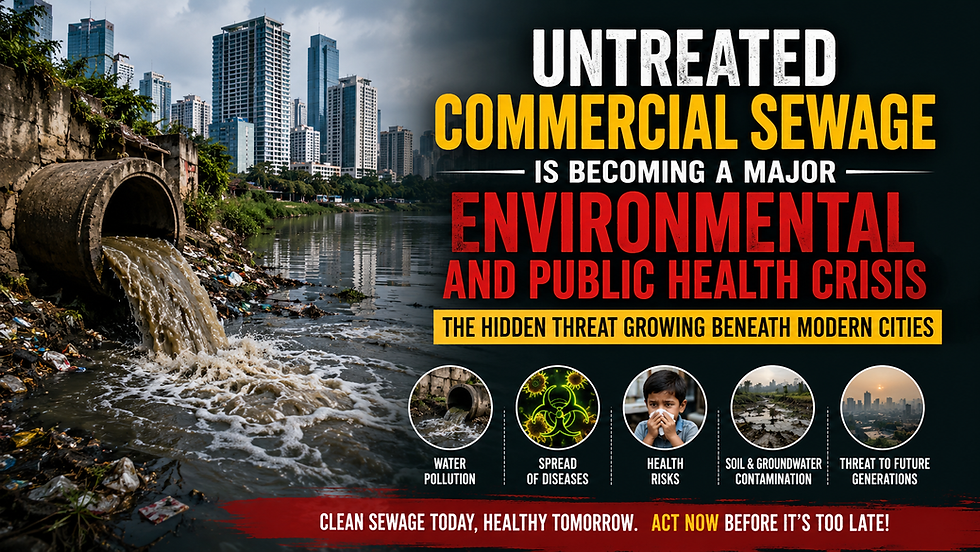
Untreated Commercial Sewage Is Becoming a Major Environmental and Public Health Crisis: The Hidden Threat Growing Beneath Modern Cities

India’s cities are expanding faster than ever before.
Massive commercial towers are rising across urban landscapes. Shopping malls glow through the night. Hotels welcome thousands of visitors daily. IT parks operate around the clock. Hospitals continue expanding to serve growing populations. Industrial parks and business hubs are transforming once-empty land into centers of economic growth.
From the outside, this development looks like progress.
But beneath this modern infrastructure, another reality is silently growing — a dangerous wastewater crisis that most people cannot see until the damage becomes irreversible.
Every commercial building produces sewage every single day.
Thousands of litres of wastewater flow continuously from toilets, kitchens, cafeterias, laundries, cooling systems, food courts, cleaning operations, and industrial activities.
Yet in many areas, sewage management systems remain outdated, overloaded, poorly maintained, or completely ignored.
The result is alarming.
Untreated commercial sewage is entering drains, lakes, rivers, groundwater, and public water systems at an increasing rate. What appears to be ordinary wastewater is actually a toxic mixture of harmful bacteria, chemicals, pathogens, organic pollutants, oils, detergents, sludge, and disease-causing contaminants.
This is no longer a small infrastructure problem.
It is becoming one of the biggest environmental and public health threats facing modern cities.
The Hidden Wastewater Crisis Growing Behind Commercial Development
Urban growth creates enormous pressure on water resources.
As more commercial buildings are constructed, water consumption rises rapidly. Every litre of freshwater entering a building eventually becomes wastewater that must be treated properly before discharge or reuse.
Unfortunately, many commercial properties still operate without efficient sewage treatment systems.
Some install low-cost plants only to satisfy approval requirements. Others run outdated systems that cannot handle current sewage loads. In many cases, maintenance is ignored completely after installation.
Over time, systems begin to fail.
Pipelines clog.
Sludge accumulates.
Blowers stop functioning.
Foul odors spread through the property.
Contaminated water starts overflowing into drainage systems.
Eventually, untreated sewage enters the environment.
What makes this crisis more dangerous is that the damage often remains invisible during the early stages. Pollution spreads silently beneath the ground, contaminating water sources slowly until surrounding communities begin experiencing serious consequences.
By the time authorities intervene, environmental damage may already be severe.
Why Commercial Sewage Is More Dangerous Than People Realize
Many people assume sewage is simply dirty water.
The reality is far more dangerous.
Commercial wastewater contains a wide range of contaminants depending on the type of facility generating it.
Hotels release grease, detergents, food waste, oils, and chemical cleaning agents.
Hospitals discharge pharmaceutical residues, pathogens, infectious waste particles, and bio-contaminants.
Shopping malls generate large volumes of restroom and food court wastewater.
IT parks and office complexes create continuous sewage flow from cafeterias, washrooms, and maintenance systems.
Industrial commercial facilities may release chemical residues, suspended solids, and harmful compounds into wastewater streams.
When untreated sewage enters lakes, rivers, or groundwater systems, it creates a chain reaction of environmental destruction.
Water quality deteriorates rapidly.
Aquatic ecosystems begin collapsing.
Oxygen levels in water bodies decrease.
Toxic algae growth increases.
Fish and aquatic organisms die.
Groundwater sources become unsafe for human use.
Agricultural lands irrigated with polluted water absorb contaminants into the soil.
Communities living near polluted zones suffer the consequences for years.
The Public Health Threat Is Becoming Extremely Serious
The sewage crisis is not only an environmental issue.
It is a growing public health emergency.
Untreated wastewater contains disease-causing microorganisms that can spread rapidly through contaminated water systems. Harmful bacteria, viruses, parasites, and pathogens thrive inside sewage-rich environments.
Poor wastewater management contributes to:
Waterborne diseases
Skin infections
Respiratory problems from toxic gases
Mosquito breeding
Foul odor exposure
Gastrointestinal illnesses
Groundwater contamination
Community sanitation problems
In densely populated commercial areas, the risks become even greater.
When sewage systems fail near hospitals, residential zones, food establishments, or public spaces, contamination spreads quickly across larger populations.
Children, elderly individuals, patients, and workers become vulnerable to unsafe environmental conditions.
Many cities are already struggling with declining freshwater quality because untreated wastewater continues entering lakes and groundwater reserves.
The long-term health impact can become devastating if commercial sewage treatment is ignored.
Why Many Commercial STPs Fail Within a Few Years
One of the biggest problems facing commercial infrastructure today is the failure of poorly designed sewage treatment systems.
Many commercial property owners focus only on initial installation cost rather than long-term operational efficiency.
As a result, low-quality systems are often installed without proper engineering design, automation, or scalability.
Initially, the system may appear functional.
But as sewage load increases, operational problems begin appearing:
Excess sludge generation
High electricity consumption
Frequent equipment failure
Odor problems
Poor treatment quality
Overflow issues
Blocked pipelines
Corrosion damage
Inefficient biological treatment
Maintenance complications
In some cases, untrained operators make the situation even worse by running systems incorrectly.
Gradually, the STP stops functioning effectively.
Untreated sewage then gets discharged directly into public drains or nearby land areas.
This not only damages the environment but also exposes businesses to legal action, public complaints, financial losses, and operational shutdown risks.
The Water Scarcity Crisis Is Directly Connected to Sewage Treatment
India is already facing severe water stress in many urban regions.
Groundwater levels continue declining.
Lakes are shrinking.
Freshwater demand is rising rapidly.
At the same time, enormous quantities of wastewater are being wasted every day because they are not treated properly.
This is one of the biggest contradictions of modern urban development.
Cities are running out of water while simultaneously allowing reusable wastewater to become pollution.
A properly designed sewage treatment plant can convert wastewater into reusable treated water suitable for:
Gardening
Landscaping
Toilet flushing
Cooling towers
Industrial reuse
Agriculture
Cleaning applications
Instead of wasting freshwater for non-potable uses, treated water can significantly reduce dependency on external water sources.
For commercial buildings, this creates both environmental and financial advantages.
Water reuse reduces tanker dependency, lowers water procurement costs, and supports long-term sustainability goals.
Businesses that ignore wastewater recycling today may face severe operational challenges in the future as water scarcity intensifies.
Government Regulations Are Becoming Stricter
Environmental compliance is no longer optional for commercial properties.
Pollution control authorities are increasing monitoring efforts across urban and industrial regions. Commercial establishments operating without functional sewage treatment systems are facing growing scrutiny.
Hotels, malls, hospitals, apartments, educational institutions, and industrial facilities are increasingly required to install and maintain operational STPs.
Failure to comply can lead to:
Heavy penalties
Legal notices
Operational restrictions
Water supply disconnections
Environmental compensation charges
Reputation damage
Project approval complications
Modern commercial infrastructure must now integrate wastewater management as a core operational responsibility rather than treating it as an afterthought.
Businesses that act early will remain safer from future regulatory pressure.
Why Smart Commercial Buildings Are Investing in Advanced STPs
Forward-thinking businesses are beginning to understand that sewage treatment is not merely about compliance.
It is about long-term operational security.
Modern commercial STPs provide multiple advantages beyond pollution control:
Reduced Water Costs
Treated wastewater reuse reduces freshwater consumption significantly.
Better Environmental Reputation
Sustainable infrastructure improves public image and brand trust.
Regulatory Protection
Proper systems help avoid penalties and compliance risks.
Odor-Free Operation
Advanced biological treatment systems minimize foul smell issues.
Lower Maintenance Problems
Well-designed automated systems reduce operational complications.
Long-Term Sustainability
Water recycling supports future urban resilience.
Improved Property Value
Commercial properties with sustainable infrastructure often attract better long-term investment interest.
As environmental awareness increases globally, businesses adopting sustainable wastewater solutions gain competitive advantages in both reputation and operational efficiency.
Why Bio STPs Are Becoming the Future of Commercial Wastewater Management
Traditional sewage treatment methods often require large space, intensive maintenance, and high operational costs.
Modern Bio STPs are changing this approach completely.
Advanced biological sewage treatment systems are designed to provide:
Efficient wastewater treatment
Lower maintenance requirements
Better odor control
Compact installation
Sustainable water recycling
Energy-efficient operation
Long-term reliability
For commercial properties facing growing wastewater challenges, Bio STPs offer a smarter and more future-ready solution.
Instead of viewing sewage as waste, modern treatment systems transform wastewater into a reusable resource.
This shift is becoming essential for sustainable urban growth.
Why Businesses Cannot Ignore This Crisis Anymore
The commercial sewage problem is no longer hidden.
Cities are experiencing increasing pressure from pollution, water shortages, environmental degradation, and infrastructure overload.
Every untreated discharge contributes to a larger ecological crisis.
Every failed sewage system increases risks for surrounding communities.
Every ignored wastewater problem pushes cities closer to environmental collapse.
Businesses that continue postponing sewage treatment upgrades may eventually face much larger financial and operational consequences.
The future belongs to commercial infrastructure that prioritizes sustainability, environmental responsibility, and smart wastewater management.
The question is no longer whether businesses should invest in proper sewage treatment.
The real question is:
How long can cities survive without it?
Why Choose Bio Synk for Commercial Sewage Treatment Solutions
Modern wastewater problems require modern engineering solutions.
Bio Synk Sewage Treatment Plant Solutions provides advanced sewage treatment systems designed for commercial buildings, hotels, hospitals, apartments, IT parks, industries, institutions, and large infrastructure projects.
Bio Synk focuses on:
Advanced Bio STP technology
Sustainable wastewater recycling
Compact and efficient systems
Low-maintenance solutions
Eco-friendly treatment processes
Reliable long-term performance
Customized commercial wastewater solutions
As urban wastewater challenges continue growing, businesses need dependable sewage treatment partners capable of delivering sustainable and future-ready systems.
The Future of Urban India Depends on Wastewater Responsibility
The next generation of cities cannot be built on polluted rivers, contaminated groundwater, and failing sewage infrastructure.
Clean water is becoming one of the world’s most valuable resources.
Every drop reused matters.
Every untreated discharge avoided matters.
Every commercial building that adopts responsible wastewater treatment becomes part of the solution instead of part of the crisis.
The sewage problem may be hidden underground today.
But the consequences will eventually rise to the surface for everyone to face.
The time to act is now.


Comments