
Business Owners Are Still Wasting Money on Wastewater: Why Water Reuse Is the Next Business Advantage


The Hidden Cost of Wastewater Most Businesses Don't See
For many business owners, water is simply another operating expense.
Water comes into the facility, gets used in bathrooms, cleaning, landscaping, production or other activities, and eventually leaves the property as wastewater.
But there is a problem with this traditional approach:
Businesses are often paying to buy water, paying to manage the wastewater, and then paying again to purchase fresh water for applications where treated wastewater could potentially be reused.
That means wastewater is not just an environmental issue.
It can also be a business-cost issue.
As water availability becomes more uncertain and operating costs continue to matter, businesses are increasingly looking at wastewater treatment not simply as a compliance requirement, but as an opportunity to reduce recurring expenses, recover water and improve long-term operational efficiency.
The question for business owners is no longer only:
“How do I treat my wastewater?”
The better question is:
“How much water, money and operational efficiency can I recover from the wastewater I already generate?”
Water Is Becoming a Strategic Business Resource
Industries, commercial buildings, hotels, hospitals, institutions, technology parks and large residential developments all depend on reliable water supplies.
At the same time, water availability can be affected by:
Urbanisation
Population growth
Drought and irregular rainfall
Groundwater restrictions
Rising water demand
Increasing industrial activity
Higher water procurement costs
Stricter environmental requirements
This creates a growing business challenge.
A company cannot simply assume that freshwater will always be available at the same cost and in the same quantity.
Forward-looking businesses therefore need to think about water security as part of their operational strategy.
One of the most practical opportunities is already available inside the facility itself:
Wastewater.
Wastewater Is Not Always Waste
Wastewater contains water that has already been purchased, transported and consumed.
After appropriate treatment, a portion of that water can potentially be recovered for suitable non-potable applications, depending on the required quality and applicable regulations.
For example, treated wastewater may be considered for:
Toilet flushing
Gardening
Landscaping
Road and common-area cleaning
Construction activities
Cooling applications
Selected industrial applications
Other approved non-potable uses
The exact reuse application should always be determined by water-quality requirements, site conditions and applicable regulatory standards.
The important concept is simple:
Treat the water once. Recover it. Reuse it responsibly.
Instead of:
Freshwater → Use → Wastewater → Disposal
businesses can work toward:
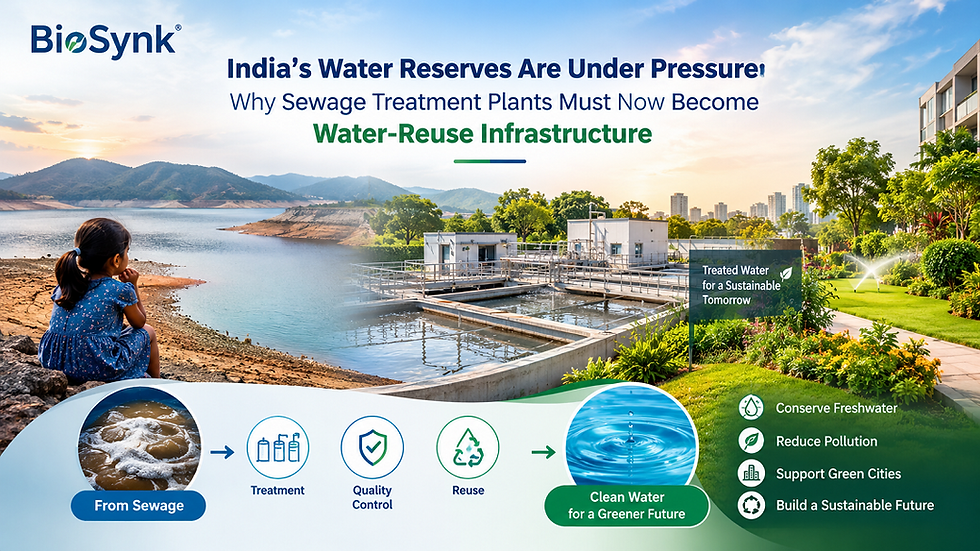
Freshwater → Use → Wastewater → Treatment → Recovery → Reuse
This is the foundation of a more circular approach to water management.
The Real Cost of a Conventional Wastewater System
When evaluating a sewage treatment plant or wastewater treatment system, many businesses focus mainly on the initial installation cost.
But the bigger financial question is:
What will this system cost to operate for the next 5, 10 or 15 years?
Recurring wastewater costs can include:
Electricity
Pumps, blowers, aeration systems and other equipment can consume significant amounts of electricity depending on the treatment technology and plant configuration.
Chemicals
Some conventional systems require regular chemical inputs for treatment, pH adjustment, disinfection or other processes.
Operators
Certain treatment systems require dedicated manpower for daily operation, monitoring and maintenance.
Mechanical Maintenance
Pumps, blowers, motors, valves and other mechanical components require servicing and replacement over time.
Sludge Management
Sludge handling, transportation and disposal can become a recurring operational burden.
Freshwater Purchase
If treated wastewater is discharged rather than reused, the business may continue purchasing freshwater for applications that could potentially use reclaimed water.
Compliance and Monitoring
Businesses may also need regular testing, documentation, maintenance and compliance support.
When these costs accumulate year after year, wastewater management can become a significant long-term operating expense.
This Is Where Water Reuse Changes the Business Equation
Imagine a business that uses large quantities of water every day.
Part of that water becomes sewage or wastewater.
Instead of treating it only as a disposal stream, the business can consider recovering it for suitable reuse applications.
This can create several potential benefits simultaneously:
Lower freshwater demand
Lower wastewater discharge
Better resource efficiency
Potential reduction in operating costs
Improved water security
This is why wastewater reuse is increasingly becoming a strategic business decision rather than simply an environmental initiative.
Why Low-Maintenance Treatment Matters
A wastewater treatment plant may remain in operation for many years.
Therefore, its long-term operating model matters just as much as its initial design.
A system that requires extensive daily intervention, high electricity consumption, frequent chemical dosing and significant mechanical maintenance can become expensive over its operating life.
A low-maintenance biological treatment approach can simplify operations and reduce recurring requirements.
BioSynk's Bio STP approach is designed around biological wastewater treatment, with an emphasis on low-maintenance operation, minimal chemical dependence and energy-efficient treatment.
For businesses, this can shift the conversation from:
“What is the purchase price of the STP?”
to:
“What is the total cost of ownership?”
That is a much more important question.
How Businesses Can Reduce Wastewater Operating Costs
A practical wastewater strategy should examine the entire lifecycle.
1. Measure Water Consumption
Understand how much water enters the facility and where it is being used.
2. Measure Wastewater Generation
Determine how much wastewater is being generated every day.
3. Identify Reuse Opportunities
Find applications where suitably treated water can replace freshwater.
4. Select Appropriate Treatment Technology
Treatment should be based on wastewater characteristics, capacity, intended reuse and applicable standards.
5. Reduce Energy Requirements
Energy consumption should be considered during technology selection and system design.
6. Reduce Chemical Dependence
Where the treatment process permits, reducing chemical requirements can simplify operations and lower recurring costs.
7. Simplify Maintenance
A system designed for straightforward operation can reduce the burden on facility teams.
8. Monitor Treated-Water Quality
Regular monitoring is essential to ensure that the treated water is suitable for its intended application and regulatory requirements.
BioSynk: Turning Wastewater Management Into a Business Advantage
This is where BioSynk's approach is different.
Rather than viewing an STP simply as an infrastructure requirement, BioSynk focuses on low-maintenance wastewater treatment, cost efficiency and opportunities for water reuse.
BioSynk's published STP solution highlights:
Up to 85% O&M Cost Savings
BioSynk promotes up to 85% savings in operation and maintenance costs, helping businesses reduce recurring expenditure associated with wastewater treatment. Actual savings depend on the project, existing system and operating conditions.
Up to 90% Electricity Cost Savings
For suitable applications and system configurations, BioSynk can target up to 90% reduction in electricity-related treatment costs compared with conventional systems.
The actual saving depends on the treatment configuration, capacity, operating conditions and baseline system.
Minimal or Zero Power Operation
BioSynk's Bio STP technology is designed to enable zero-power operation in suitable configurations, reducing dependence on continuous electrical equipment.
No Harsh Chemicals
The biological treatment approach reduces dependence on chemical-intensive treatment processes, supporting simpler and more environmentally responsible operation.
Operator-Free / Low-Maintenance Operation
The system is designed to minimise day-to-day operational complexity and reduce the need for intensive skilled manpower.
Reduced Sludge Burden
BioSynk focuses on treatment approaches that can significantly reduce the operational burden associated with conventional sludge management, depending on system configuration.
Odour-Free and Silent Operation
The BioSynk system is positioned for low-noise and odour-controlled operation, making it suitable for locations where conventional wastewater systems can create nuisance concerns.
Compact and Space-Efficient
For urban projects where land is valuable, compact wastewater treatment infrastructure can help businesses use their available site more efficiently. BioSynk provides solutions for residential, commercial and industrial applications.
Fast Installation
BioSynk currently highlights 48-hour installation for suitable pre-engineered deployments. Project timelines can vary depending on site conditions and scope.
Compliance and NOC Support
Wastewater treatment is also about environmental compliance.
BioSynk provides support related to applicable Pollution Control Board requirements, documentation and NOC processes.
The Biggest Opportunity: Reuse the Water You Already Have
The most important benefit of wastewater treatment may not be the treatment itself.
It is what happens after treatment.
If suitable treated water can be reused, businesses can potentially reduce their dependence on freshwater.
For example, a commercial property may use treated wastewater for landscaping and toilet flushing.
An industrial facility may identify suitable process or utility applications.
A hotel may reuse treated water for landscaping or other permitted non-potable applications.
An institution may reuse treated water for gardening and flushing.
The opportunity differs from project to project.
But the principle remains the same:
Don't treat water only to throw it away. Treat it with a reuse strategy in mind.
Wastewater Reuse and the Circular Water Economy
The future of water management is moving toward a circular model.
Instead of treating water as a one-time-use resource, businesses can look at the complete water cycle.
Traditional Model
Take → Use → Discharge → Replace
Circular Model
Take → Use → Treat → Recover → Reuse → Repeat
This approach can help businesses improve resource efficiency while reducing pressure on freshwater sources.
It can also support broader sustainability goals and corporate environmental commitments.
For global businesses, water reuse is increasingly becoming part of a larger conversation around ESG, resource efficiency, climate resilience and sustainable operations.
Why Business Owners Should Act Now
Waiting until water becomes expensive, unavailable or heavily regulated can be more costly than planning ahead.
A business should consider wastewater treatment and reuse before water constraints become an emergency.
The right time to ask these questions is now:
How much water does our business consume?
How much wastewater do we generate?
How much freshwater could potentially be replaced with treated water?
How much are we spending on electricity and maintenance for wastewater treatment?
Can our existing STP be upgraded?
Can wastewater be reused safely and legally for suitable applications?
What will our wastewater system cost over the next 10 years?
These questions can reveal opportunities that are invisible when wastewater is viewed only as a disposal problem.
From Wastewater Cost to Water Asset
The business mindset around wastewater needs to change.
Wastewater should not automatically mean:
Cost → Treatment → Disposal
It can instead become:
Treatment → Recovery → Reuse → Resource Efficiency
That shift can help businesses move from reactive wastewater management to proactive water management.
The strongest wastewater strategy is not necessarily the system with the lowest initial purchase price.
It is the system that delivers the right balance of:
Treatment performance + compliance + reliability + operating cost + maintenance + water recovery + reuse.
The Future of Business Water Management
Water scarcity, increasing demand and environmental regulations are changing the way businesses think about wastewater.
The companies that adapt early can potentially gain advantages through:
Reduced freshwater dependence
Lower wastewater operating costs
Better resource efficiency
Improved environmental performance
More resilient water management
Increased opportunities for treated-water reuse
Wastewater treatment is therefore becoming more than an environmental responsibility.
It is becoming a business strategy.
The question is no longer whether businesses should think about wastewater.
The question is:
How much value are they leaving behind by treating wastewater as waste?
BioSynk: Treat. Recover. Reuse.
BioSynk provides Bio STP solutions for residential, commercial, institutional and industrial applications, with a focus on low-maintenance wastewater treatment, resource efficiency and treated-water reuse.
From sewage treatment to sustainable water management, the objective is simple:
Treat wastewater at source.Reduce operating burden.Recover water where appropriate.Reuse water responsibly.
For businesses looking to reduce wastewater-related operating costs and explore a more sustainable water-management strategy, BioSynk can help assess the appropriate treatment approach for the project.
Explore BioSynk Sewage Treatment Plant Solutions
BioSynk Sewage Treatment Plant: https://www.biostp.co.in/sewage-treatment-plant
Every drop of wastewater can become an opportunity.
Treat. Recover. Recycle. Upgrade. Reuse.


Comments