
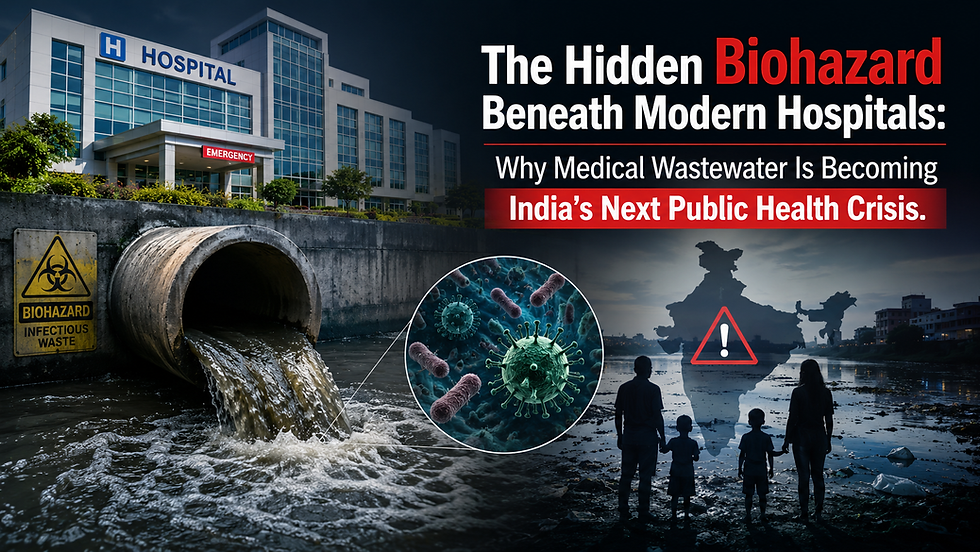
The Hidden Biohazard Beneath Modern Hospitals: Why Medical Wastewater Is Becoming India’s Next Public Health Crisis
- MARKETING BIOSYNK
- May 16
- 6 min read

Introduction: Hospitals Save Lives — But What Happens to the Water They Discharge?
Across India, hospitals are expanding faster than ever before. New multi-specialty healthcare centers, diagnostic laboratories, emergency care facilities, medical colleges, and private hospitals are rising in every growing city and industrial corridor. Healthcare infrastructure is becoming a symbol of progress, modernization, and public welfare.
But beneath this progress lies a dangerous and often ignored environmental reality.
Every hospital generates enormous volumes of wastewater every single day — wastewater filled with harmful pathogens, chemical residues, pharmaceutical contaminants, blood particles, disinfectants, laboratory waste, antibiotic compounds, and disease-causing microorganisms. Much of this wastewater eventually enters municipal drains, groundwater systems, lakes, rivers, or surrounding ecosystems.
The alarming truth is that many healthcare facilities still lack advanced sewage treatment systems capable of handling highly contaminated medical wastewater safely.
This is not just an environmental issue anymore.
It is rapidly becoming a national public health crisis.
Because when untreated or poorly treated hospital wastewater enters the environment, the consequences extend far beyond hospital walls. It affects drinking water, agricultural systems, groundwater quality, urban sanitation, biodiversity, and ultimately human health itself.
India’s healthcare sector is growing aggressively.
But wastewater management infrastructure is struggling to keep pace.
And that gap is becoming increasingly dangerous.
The Hidden Composition of Hospital Wastewater Most People Never See
To the naked eye, wastewater flowing out of a hospital may look like ordinary sewage.
In reality, it is one of the most biologically dangerous forms of wastewater generated in urban infrastructure.
Hospital wastewater often contains:
Infectious bacteria and viruses
Antibiotic-resistant microorganisms
Blood-contaminated fluids
Chemical disinfectants
Laboratory chemicals
Pharmaceutical residues
Pathological waste particles
Organic pollutants
Heavy metals from medical equipment
Toxic cleaning agents
Unlike domestic sewage, medical wastewater contains highly concentrated contaminants capable of surviving conventional drainage systems.
Many disease-causing organisms remain active even after entering sewage pipelines.
This means untreated medical wastewater can become a transport system for dangerous pathogens into public ecosystems.
As healthcare facilities grow larger, the wastewater burden also increases dramatically.
And unfortunately, in many areas, sewage infrastructure has not evolved fast enough to safely manage this threat.
Why Hospital Wastewater Has Become More Dangerous in Modern Healthcare
Modern hospitals use stronger chemicals, advanced pharmaceuticals, powerful antibiotics, radioactive materials, sterilization compounds, and specialized laboratory agents.
While these technologies improve healthcare outcomes, they also create more chemically complex wastewater streams.
One of the biggest emerging threats is antibiotic-resistant bacteria.
When antibiotic residues mix with wastewater, bacteria exposed to these compounds can gradually evolve resistance. Over time, these resistant microorganisms may spread into water systems, soil, and public environments.
This creates a silent but serious danger.
Because future infections may become harder to treat.
The World Health Organization has repeatedly warned about antimicrobial resistance becoming one of the largest global health threats of the century.
Hospital wastewater plays a major role in this growing problem.
Without proper treatment infrastructure, healthcare institutions unintentionally contribute to long-term environmental contamination and microbial resistance.
India’s Expanding Healthcare Infrastructure Is Increasing Wastewater Pressure
India is experiencing rapid healthcare expansion.
New hospitals are being developed in:
Chennai
Bengaluru
Hyderabad
Mumbai
Pune
Delhi NCR
Coimbatore
Ahmedabad
Tier-2 smart cities
Industrial healthcare corridors
Medical tourism is also accelerating infrastructure growth.
Large hospital campuses now include:
Operation theatres
ICUs
Diagnostic labs
Research divisions
Pharmacy units
Food courts
Staff accommodation
Laundry facilities
All of these generate wastewater continuously.
A single large hospital can produce thousands of liters of sewage every day.
Without efficient sewage treatment systems, urban drainage networks become overloaded, increasing pollution risks across entire cities.
The problem becomes even worse during heavy rainfall, flooding, or drainage failures.
Contaminated wastewater can spread rapidly into nearby communities.
Groundwater Contamination Is Becoming a Serious Urban Threat
Many hospitals are located in densely populated urban areas where groundwater remains an essential water source.
When untreated wastewater leaks into soil or drainage systems, harmful contaminants gradually seep underground.
This affects:
Borewell water
Residential water systems
Agricultural irrigation
Urban lakes
Community water sources
The contamination process is often invisible.
People may continue using polluted groundwater without realizing the long-term health risks.
In many Indian cities, groundwater tables are already under severe stress.
Adding medical wastewater contamination creates another layer of environmental pressure.
This is why hospital wastewater treatment can no longer be treated as a secondary infrastructure requirement.
It is now a critical environmental protection necessity.
Why Pollution Control Regulations Are Becoming Stricter for Hospitals
Government authorities and pollution control boards are increasingly tightening environmental regulations for hospitals and healthcare institutions.
Today, hospitals are expected to maintain:
Proper sewage treatment systems
Wastewater discharge compliance
Pollution monitoring standards
Environmental sustainability practices
Safe sludge disposal systems
Water recycling mechanisms
Environmental non-compliance can result in:
Legal penalties
Operational restrictions
Environmental notices
Reputational damage
Public criticism
Licensing complications
Modern healthcare institutions are now expected to demonstrate environmental responsibility alongside medical excellence.
Patients, investors, authorities, and communities increasingly evaluate hospitals based on sustainability practices.
Hospitals that ignore wastewater infrastructure may face growing operational risks in the future.
Why Traditional Sewage Systems Often Fail in Hospitals
Conventional sewage treatment systems were not originally designed for highly contaminated medical wastewater.
Hospital wastewater requires:
Advanced biological treatment
Pathogen reduction
Odor control
Chemical stabilization
Efficient sludge management
Long-term operational reliability
Many outdated systems struggle with:
High chemical loads
Fluctuating wastewater volumes
Maintenance complexity
Poor bacterial efficiency
Excess sludge generation
High operational costs
As a result, partially treated wastewater may still contain dangerous contaminants.
This is why hospitals increasingly need specialized Bio STP systems designed specifically for healthcare infrastructure.
Sustainable Hospitals Require Sustainable Wastewater Infrastructure
The future of healthcare is no longer defined only by advanced equipment or medical technology.
It is also defined by environmental responsibility.
Modern hospitals are now expected to operate as sustainable institutions that protect both patients and ecosystems.
This includes:
Energy-efficient infrastructure
Water conservation
Waste recycling
Green building standards
Responsible wastewater treatment
Healthcare institutions that invest in sustainable wastewater management gain major long-term advantages:
Better compliance readiness
Improved environmental reputation
Reduced pollution risk
Lower operational strain
Better water reuse opportunities
Stronger public trust
As urban populations continue growing, sustainable sewage treatment will become one of the most important pillars of future-ready healthcare infrastructure.
The Public Health Impact Extends Far Beyond Hospital Boundaries
Hospital wastewater pollution does not remain confined inside hospital compounds.
It eventually affects:
Families
Residential communities
Public water systems
Urban ecosystems
Children
Future generations
Contaminated water contributes to:
Disease transmission
Waterborne infections
Ecological imbalance
Soil degradation
Public sanitation risks
In densely populated cities, even small failures in wastewater management can create large-scale environmental consequences.
This is why sewage treatment is not just an engineering process.
It is a public health responsibility.
Why Advanced Bio STP Systems Are Becoming Essential for Hospitals
Healthcare facilities now require advanced sewage treatment systems capable of handling complex wastewater safely and efficiently.
Modern Bio STP systems help hospitals:
Treat wastewater effectively
Reduce harmful contaminants
Improve environmental compliance
Support water recycling
Minimize odor issues
Lower maintenance challenges
Improve operational sustainability
Advanced biological treatment technologies are designed to support long-term hospital infrastructure growth while reducing environmental impact.
As environmental awareness grows across India, hospitals with sustainable wastewater systems will become more trusted, respected, and future-ready.
Why Choose Bio Synk for Hospital Sewage Treatment Solutions
At Bio Synk Hospital STP Solutions, we understand that hospitals require far more than ordinary sewage treatment systems.
Healthcare wastewater demands advanced, reliable, environmentally responsible treatment infrastructure designed specifically for medical facilities.
Our advanced Bio STP solutions are developed to support:
Hospitals
Multi-specialty healthcare centers
Medical colleges
Laboratories
Diagnostic facilities
Healthcare campuses
We focus on:
Eco-friendly wastewater treatment
Sustainable operations
Efficient biological treatment
Long-term performance
Reduced environmental impact
Compliance-focused infrastructure
As India’s healthcare sector continues expanding, responsible wastewater management will become one of the defining pillars of sustainable healthcare infrastructure.
Hospitals that invest in advanced sewage treatment today are not only protecting compliance standards — they are protecting communities, ecosystems, groundwater, and future generations.
Conclusion: Saving Lives Must Also Mean Protecting the Environment
Hospitals exist to heal people.
But true healthcare responsibility must extend beyond operation theatres and patient wards.
It must include the protection of water, soil, ecosystems, and public health itself.
The wastewater crisis growing beneath modern hospitals can no longer remain invisible.
As healthcare infrastructure expands across India, sustainable sewage treatment will become one of the most critical environmental priorities of the coming decade.
The hospitals that act early will lead the future of responsible healthcare.
Because protecting human life also means protecting the environment that sustains it.


Comments