
The ₹Crore Mistake Industrial Parks Make: Ignoring Modern Sewage Treatment Infrastructure


Introduction: The Costly Mistake Hidden Beneath Industrial Growth
Industrial parks are the backbone of economic development. They attract manufacturers, create jobs, boost exports, and contribute significantly to regional growth. However, beneath the impressive factories, warehouses, and production facilities lies a challenge that many industrial park developers overlook until it becomes a costly crisis: sewage and wastewater management.
Many industrial parks invest crores in land development, power infrastructure, roads, and production facilities but fail to prioritize modern sewage treatment infrastructure. This oversight often leads to environmental penalties, operational disruptions, rising water costs, regulatory violations, and reputational damage.
As water scarcity becomes a growing concern across India, industrial parks that continue to rely on outdated wastewater systems are putting their future at risk. The reality is simple: untreated or poorly treated sewage is no longer just an environmental issue—it is a major business risk.
Today, a modern Industrial Park Sewage Treatment Plant is not merely an environmental requirement; it is a strategic investment that protects profitability, ensures compliance, and secures long-term sustainability.
The Growing Wastewater Challenge in Industrial Parks
Industrial parks accommodate hundreds or even thousands of employees daily. Alongside industrial wastewater, significant quantities of domestic sewage are generated from office buildings, canteens, restrooms, dormitories, and support facilities.
As industrial zones expand, sewage generation increases dramatically. Without adequate treatment systems, wastewater can quickly become a source of environmental pollution and operational challenges.
Common issues include:
Overflowing sewage networks
Groundwater contamination
Foul odors affecting employees
Pollution of nearby lakes and rivers
Health risks for workers and local communities
Regulatory notices from pollution control authorities
Unfortunately, many industrial developers only address these issues after they become severe, resulting in costly corrective measures.
Why Ignoring Sewage Treatment Can Cost Crores
1. Regulatory Penalties and Legal Consequences
Environmental regulations across India are becoming increasingly stringent. Industrial parks are expected to comply with wastewater discharge standards established by regulatory authorities.
Failure to meet these requirements can result in:
Heavy monetary penalties
Legal proceedings
Project delays
Closure notices
Suspension of operating permissions
A single compliance failure can lead to losses running into lakhs or even crores of rupees.
Proactive investment in modern sewage treatment infrastructure significantly reduces these risks and demonstrates environmental responsibility.
2. Rising Water Costs Are Eating Into Profits
Water is no longer an unlimited resource.
Across many industrial regions, groundwater levels are declining rapidly. Municipal water supplies are becoming increasingly expensive, while industrial demand continues to rise.
Industrial parks that discharge wastewater instead of recycling it are effectively throwing away a valuable resource every day.
Modern sewage treatment plants enable:
Water recycling
Landscape irrigation
Toilet flushing
Cooling tower applications
Utility water reuse
The result is substantial savings on freshwater procurement costs year after year.
Many industrial parks recover their investment in sewage treatment systems through water savings alone.
3. Environmental Damage Creates Long-Term Liability
Untreated sewage does not simply disappear.
It infiltrates:
Soil
Groundwater aquifers
Stormwater systems
Lakes and rivers
Over time, contamination can spread beyond industrial boundaries, affecting nearby communities and ecosystems.
Environmental damage often leads to:
Cleanup expenses
Compensation claims
Community opposition
Negative media attention
The financial impact of environmental negligence can far exceed the cost of installing a proper treatment system.
4. Investor Expectations Are Changing
Today's investors evaluate more than financial performance.
Environmental, Social, and Governance (ESG) standards are becoming critical decision-making factors.
Industrial parks with poor environmental practices may struggle to attract:
International investors
Multinational manufacturers
Sustainability-focused businesses
Green financing opportunities
Modern sewage treatment infrastructure demonstrates a commitment to responsible development and strengthens investor confidence.
5. Poor Wastewater Management Impacts Business Reputation
Reputation is one of the most valuable assets any industrial park possesses.
When sewage problems become visible, stakeholders notice immediately.
Issues such as:
Foul odors
Polluted water bodies
Worker complaints
Environmental violations
can significantly damage public perception.
In today's digital environment, negative publicity spreads quickly and can influence future business opportunities.
A modern sewage treatment system helps protect brand value while reinforcing environmental leadership.
The Smart Solution: Modern Industrial Park Sewage Treatment Plants
Modern sewage treatment technology has evolved significantly over the past decade.
Advanced systems now provide:
High treatment efficiency
Reduced operational costs
Compact installation footprints
Automated monitoring
Reliable compliance performance
Water reuse capabilities
These solutions transform wastewater from a liability into a valuable resource.
Instead of viewing sewage treatment as an expense, successful industrial parks recognize it as an infrastructure investment that delivers measurable returns.
Why Water Recycling Is the Future of Industrial Parks
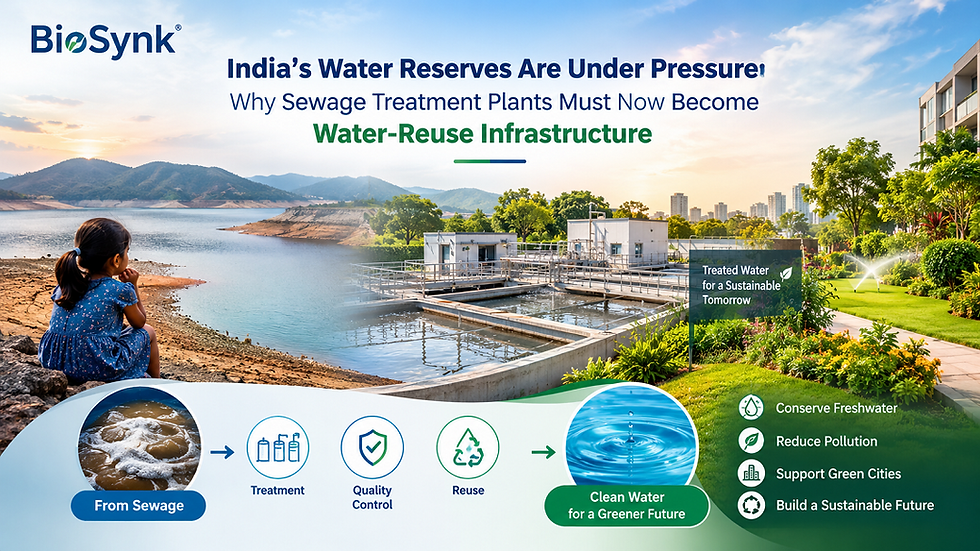
India faces increasing water stress every year.
Industrial parks that continue relying solely on fresh water sources may face significant operational challenges in the future.
Water recycling offers a sustainable alternative.
Benefits include:
Reduced Freshwater Dependency
Recycled water reduces demand on groundwater and municipal supplies.
Lower Operating Costs
Less freshwater consumption means lower monthly utility expenses.
Improved Sustainability Ratings
Environmental performance becomes stronger and more attractive to investors.
Greater Operational Resilience
Water reuse ensures continuity even during supply shortages.
Forward-thinking industrial parks are already integrating wastewater recycling into their long-term growth strategies.
How Bio STP Technology Delivers Better Results
Traditional treatment systems often require extensive maintenance, large land areas, and significant operational oversight.
Modern Bio STP systems offer a smarter alternative.
Key advantages include:
High Treatment Efficiency
Advanced biological processes effectively remove contaminants and improve water quality.
Compact Design
Suitable for industrial parks where land optimization is critical.
Lower Energy Consumption
Efficient operation helps reduce long-term expenses.
Reduced Maintenance Requirements
Automated systems simplify management and improve reliability.
Sustainable Water Reuse
Treated water can be safely reused for multiple non-potable applications.
These advantages make Bio STP technology particularly suitable for modern industrial developments.
The Business Case for Immediate Action
Every day an industrial park operates without an efficient sewage treatment system, it faces unnecessary risks.
Those risks include:
Rising water costs
Regulatory exposure
Environmental liabilities
Operational inefficiencies
Reputation damage
Conversely, industrial parks that invest in modern treatment infrastructure gain:
Compliance confidence
Long-term cost savings
Improved sustainability
Better investor appeal
Stronger environmental stewardship
The financial benefits often outweigh the initial investment many times over.
Why Choose Bio Synk for Industrial Park Sewage Treatment Solutions
At Bio Synk, we understand the unique wastewater challenges faced by industrial parks, manufacturing clusters, logistics hubs, and integrated industrial developments.
Our advanced Industrial Park Sewage Treatment Plant solutions are designed to deliver:
✔ Reliable regulatory compliance
✔ Efficient wastewater treatment
✔ Water recycling and reuse
✔ Reduced operational costs
✔ Sustainable infrastructure development
✔ Long-term environmental protection
Whether you are developing a new industrial park or upgrading existing facilities, our expert team provides customized solutions that align with your operational goals and environmental responsibilities.
Learn more about our Industrial Park Sewage Treatment Plant solutions here:
Conclusion: Don't Let a Preventable Mistake Cost Your Industrial Park Crores
The industrial parks that thrive in the coming decade will be those that view wastewater management as a strategic asset rather than a regulatory obligation.
Ignoring modern sewage treatment infrastructure may appear to save money today, but the hidden costs can be enormous. Regulatory penalties, water scarcity, environmental liabilities, and reputational damage can quickly transform a minor oversight into a multi-crore mistake.
The smarter path is clear.
Invest in advanced sewage treatment infrastructure, embrace water recycling, and build an industrial park that is prepared for the future.
Because sustainable growth is not just about producing more—it is about managing resources wisely, protecting the environment, and securing long-term profitability.


Comments