
Tamil Nadu Can Lead India in Decentralised Wastewater Treatment: A Practical Roadmap for Rural & Semi-Urban Water Reuse


Treat Wastewater at Source. Reuse Water at Source.
Tamil Nadu has long been recognised for its strong focus on water supply, sanitation, urban infrastructure and local-government development. As the State continues to urbanise and rural settlements become more densely developed, the next major challenge is no longer simply providing water — it is managing the wastewater generated after that water is used.
Every village, town, apartment, institution, hospital, school, hotel, commercial establishment and industrial development generates wastewater.
The question is no longer whether this wastewater will be generated.
The real question is:
How efficiently can Tamil Nadu collect, treat, reuse and manage that wastewater?
A practical answer is to complement large centralised sewerage infrastructure with decentralised wastewater treatment systems wherever local conditions make such systems appropriate.
This approach can help Tamil Nadu expand wastewater treatment closer to the point of generation, reduce pressure on freshwater resources and create more opportunities for treated-water reuse.
The Government of Tamil Nadu has already established a strong policy direction around wastewater treatment, septage management and reuse. The State's Waste Water Reuse Policy was launched in December 2019 with a vision of maximising sewage collection and treatment and sustainably reusing treated wastewater to reduce dependence on freshwater resources.
The next opportunity is to take this vision deeper into rural Tamil Nadu, semi-urban settlements, institutions, government facilities and growing local communities.
Why Tamil Nadu Needs a New Approach to Wastewater Management
Tamil Nadu has a large and diverse network of urban and rural local bodies.
The Rural Development and Panchayat Raj Department currently states that there are 12,525 Village Panchayats, 388 Panchayat Unions and 36 District Panchayats under its purview.
At the same time, Tamil Nadu's urban local-government structure includes corporations, municipalities and town panchayats.
This creates a wide range of wastewater-management conditions.
A large metropolitan area may require a major underground sewerage network and a high-capacity centralised STP.
A smaller town may require a different model.
A rural or peri-urban settlement may have limited sewerage coverage, dispersed wastewater generation and limited land or operating resources.
Therefore, one wastewater-treatment model cannot necessarily fit every location.
Tamil Nadu needs a combination of:
Centralised sewage treatment plants
Decentralised sewage treatment plants
Faecal Sludge Treatment Plants
Greywater treatment systems
Cluster-based treatment facilities
Treated-water reuse systems
Appropriate sewerage and collection infrastructure
The objective should be simple:
Every wastewater stream should have a safe treatment and reuse or disposal pathway appropriate to its characteristics.
What Is Decentralised Wastewater Treatment?
Decentralised wastewater treatment means treating wastewater closer to where it is generated rather than depending entirely on one large treatment facility located far away.
For example, instead of transporting every litre of wastewater from a small settlement across a long distance to a central facility, a suitably designed local treatment system can treat wastewater closer to the source.
This can be particularly relevant for:
Rural settlements
Peri-urban villages
Small institutions
Government campuses
Schools and colleges
Hospitals
Residential communities
Hotels
Commercial developments
Industrial campuses
Local public facilities
The correct approach should always depend on wastewater quantity, wastewater characteristics, population, land availability, site conditions, collection infrastructure and applicable regulatory requirements.
Decentralisation should therefore complement, not automatically replace, existing centralised infrastructure.
Tamil Nadu Already Has the Foundation for This Approach
Tamil Nadu's existing wastewater programmes already demonstrate the importance of decentralised and cluster-based approaches.
The Rural Development and Panchayat Raj Department describes greywater-management measures including community soak pits, horizontal and vertical filters, constructed wetlands, root-zone treatment and phytorids in rural areas.
The Department has also undertaken cluster mapping for faecal sludge management.
According to the Department, mapping across 12,525 village panchayats and 649 urban local bodies identified 9,344 panchayats that could be clustered with nearby STP/FSTP treatment facilities across four phases. The Department states that 1,817 village panchayats are included in Phase I, while 7,527 are covered in Phases II and III, with the remaining 3,181 planned for new rural FSTPs under Phase IV where clustering is not feasible.
This is an important development.
It shows that wastewater management in rural Tamil Nadu is not simply about constructing isolated treatment plants.
It is also about creating a connected treatment ecosystem involving villages, urban local bodies, STPs, FSTPs, collection systems and safe disposal or reuse.
The Opportunity: Move from Wastewater Disposal to Water Recovery
Wastewater should not always be viewed as waste.
After appropriate treatment, wastewater can become a source of recovered water for suitable non-potable applications.
Tamil Nadu's Waste Water Reuse Policy specifically aims to promote treated wastewater as an economic resource and reduce dependence on freshwater resources.
The State has already demonstrated reuse of secondary treated effluent in different locations.
Government information lists examples including agricultural use, industrial use and cooling applications in places such as Nagapattinam, Dindigul, Tirunelveli, Pollachi, Chinnamanur, Karur, Arakkonam and Coimbatore.
This provides an important lesson:
The future of wastewater management should not end at treatment. It should continue to reuse.
A Proposed Model for Rural and Semi-Urban Tamil Nadu
A practical decentralised wastewater strategy can follow a simple model:
Wastewater Generation
↓
Local Collection
↓
Preliminary Treatment
↓
Biological Treatment
↓
Filtration / Polishing
↓
Disinfection Where Required
↓
Treated Water Storage
↓
Appropriate Non-Potable Reuse
The exact treatment technology should be selected after evaluating the local wastewater characteristics and required treated-water quality.
This model can be adapted for different scales.
Village Level
Small and appropriate treatment systems can be considered for settlements where centralised sewerage is not practical.
Cluster Level
Several nearby villages can potentially share treatment infrastructure where distances, transport arrangements and economics make clustering practical.
Institutional Level
Government schools, colleges, hospitals, training centres, residential campuses and other institutions can treat wastewater within their premises where appropriate.
Semi-Urban Level
Growing settlements can use decentralised treatment as an intermediate or complementary solution while larger sewerage infrastructure is developed.
Industrial and Commercial Level
Commercial and industrial campuses can treat domestic sewage locally, with separate treatment arrangements for industrial process wastewater where required.
Why Underground STPs Can Be Useful for Tamil Nadu
Land availability is an important consideration in many urban and semi-urban projects.
A conventional above-ground treatment facility can occupy valuable surface space.
For suitable projects, an underground RCC sewage treatment plant can provide an alternative approach.
The treatment tanks can be constructed below ground level, allowing the surface area to potentially remain available for:
Roads
Parking
Landscaping
Public spaces
Gardens
Walkways
Other infrastructure
The use of underground infrastructure should always be evaluated based on soil conditions, groundwater conditions, structural design, ventilation, access, safety and construction requirements.
For government projects, the objective should not simply be to hide the treatment system underground.
The objective should be to create safe, durable and maintainable infrastructure that uses land efficiently.
Decentralised STPs Can Support Rural Development
Wastewater management is closely connected to rural development.
Poorly managed wastewater can stagnate near homes, roads and public spaces.
This can create environmental and sanitation challenges.
Tamil Nadu's rural greywater programme already recognises the importance of preventing wastewater stagnation and improving wastewater handling through local treatment measures.
A decentralised treatment strategy can strengthen this approach where higher levels of treatment are required.
For suitable locations, the system could include:
Household or community collection
Drainage improvements
Screening
Biological treatment
Filtration
Disinfection
Treated-water storage
Reuse infrastructure
Monitoring
The final system should be selected according to the local wastewater stream.
Not every rural location requires the same technology.
Government Schools and Colleges Can Become Demonstration Sites
Tamil Nadu has thousands of public institutions where wastewater is generated every day.
Government schools, colleges, hostels, hospitals and training institutions can become important demonstration sites for decentralised wastewater treatment.
A suitable institutional STP can allow the campus to:
Treat its own wastewater
Reuse treated water for landscaping
Reduce freshwater demand for non-potable applications
Improve sanitation infrastructure
Demonstrate environmental responsibility
Educate students about water conservation
This creates an opportunity to combine infrastructure with environmental education.
A school that treats and reuses its wastewater can become a practical example of the circular water economy.
Government Hospitals Need Reliable Wastewater Management
Hospitals are high-water-consumption facilities and require careful wastewater management.
Domestic sewage and healthcare-related wastewater streams should be properly characterised, and additional treatment requirements should be considered where applicable.
A wastewater treatment system for a government hospital should be designed around:
Wastewater quantity
Peak flow
Wastewater characteristics
Required treatment quality
Regulatory requirements
Odour control
Operational reliability
Maintenance access
Treated-water reuse
For large government hospitals, wastewater treatment should be considered as part of the overall infrastructure plan rather than as an afterthought.
Panchayat-Level Wastewater Planning Should Include Reuse
One of the most important recommendations for Tamil Nadu is to connect treatment planning with reuse planning.
A treatment plant should not be designed first and the question of what happens to treated water asked later.
The intended reuse application should be considered during project planning.
Potential applications may include:
Landscaping
Public gardens
Roadside green belts
Toilet flushing
Cleaning
Agriculture where appropriate and permitted
Industrial applications where appropriate
Other non-potable uses
The required treatment level should be determined based on the intended reuse.
This creates a better planning principle:
Design the treatment system around the water's final destination.
Cluster-Based Wastewater Treatment Can Improve Infrastructure Efficiency
Tamil Nadu's existing approach to clustering faecal sludge management demonstrates how nearby local bodies can be connected to designated treatment facilities.
The Government's urban local-body information describes a cluster approach in which collection points are grouped around designated STPs, with clusters historically planned around approximately 5–10 km radii in the relevant septage-management framework.
A similar planning philosophy can be considered more broadly for appropriate wastewater infrastructure.
Instead of asking:
“Does every village need its own large treatment plant?”
The better question is:
“What is the most technically and economically appropriate treatment arrangement for this group of communities?”
In some locations, the answer may be a local decentralised STP.
In others, it may be a shared cluster facility.
In larger urban areas, it may be a centralised sewerage and STP system.
The solution should be based on geography, population, wastewater quantity, land, transport, operating capability and lifecycle cost.
A Five-Point Wastewater Strategy for Tamil Nadu
Tamil Nadu can strengthen decentralised wastewater management through five complementary priorities.
1. Map Wastewater Generation
Every local body should understand where wastewater is generated, how much is generated and how it is currently managed.
2. Identify Treatment Gaps
Locations with untreated sewage, wastewater stagnation or inadequate treatment should be prioritised.
3. Select the Right Treatment Model
Depending on the location, the solution may be:
Centralised STP
Decentralised STP
FSTP
Co-treatment
Greywater treatment
Cluster-based treatment
A combination of systems
4. Plan Water Reuse Before Construction
Identify suitable reuse applications before finalising the treatment design.
5. Measure Performance
Treatment plants should be monitored for:
Flow
Water quality
Energy consumption
Maintenance
Reliability
Sludge management
Reuse quantity
This allows government agencies to evaluate not just whether a plant was constructed, but whether it continues to deliver its intended public benefit.
Technology Should Follow the Need — Not the Other Way Around
There is no universal wastewater-treatment technology that should be installed everywhere.
A responsible government wastewater programme should begin with the problem.
The questions should be:
What wastewater is being generated?
How much wastewater is generated?
Where is it generated?
What treatment quality is required?
Where can the treated water be reused?
What land is available?
What level of operation and maintenance can realistically be supported?
Only after answering these questions should the treatment technology be selected.
Biological sewage treatment can be an important option for suitable domestic wastewater applications, but the final technology and configuration should be determined through proper engineering assessment.
Bio Synk's Proposal for Tamil Nadu
Bio Synk believes Tamil Nadu can create a stronger wastewater-management network by combining centralised infrastructure with decentralised biological sewage treatment solutions wherever appropriate.
Our focus is on practical wastewater treatment for:
Rural and semi-urban communities
Apartments and housing projects
Government institutions
Schools and colleges
Hospitals
Hotels
Commercial buildings
Industrial campuses
Public infrastructure
For suitable projects, Bio Synk's approach includes underground RCC treatment infrastructure designed to reduce the surface footprint of the treatment facility.
The objective is not simply to install another STP.
The objective is to support a complete wastewater-management cycle:
Collect → Treat → Reuse → Monitor
Bio Synk can support project-specific assessment, system selection, design, installation and commissioning based on the wastewater requirement and site conditions.
A Government-Industry Partnership Opportunity
Tamil Nadu's wastewater challenge is too large to be solved by one department, one technology or one organisation.
Government agencies establish policy, standards, infrastructure programmes and public-service objectives.
Local bodies understand community-level requirements.
Engineering organisations and technology providers can contribute treatment solutions, implementation capability and technical expertise.
The strongest model is therefore collaboration.
Bio Synk is ready to participate in discussions, technical evaluations and pilot projects where decentralised biological wastewater treatment may be appropriate.
A pilot project could demonstrate:
Wastewater treatment performance
Treated-water reuse
Land utilisation
Operating requirements
Lifecycle cost
Maintenance requirements
Community acceptance
Successful models can then be adapted to other suitable locations.
From Wastewater to Water Security
Tamil Nadu's water future will depend not only on finding new sources of freshwater.
It will also depend on using existing water resources more efficiently.
Every litre of appropriately treated wastewater that is reused for a suitable non-potable purpose is potentially one less litre of freshwater required for that application.
This is the basic principle behind a circular water economy.
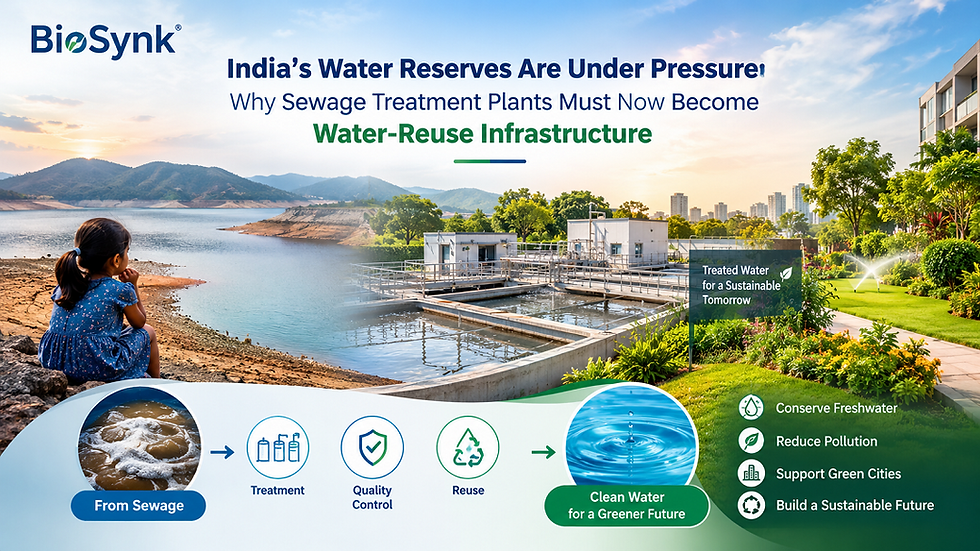
Freshwater → Use → Wastewater → Treatment → Reuse → Conservation
Tamil Nadu has already taken important steps towards this direction through wastewater reuse policy, sewerage infrastructure, septage management, greywater management and cluster-based treatment planning.
The next opportunity is to scale appropriate solutions to the places where conventional centralised infrastructure may not be the only practical answer.
A Practical Vision for Tamil Nadu
Imagine a future in which:
A village does not allow wastewater to stagnate in public areas.
A government school treats and reuses its wastewater.
A hospital manages its sewage responsibly.
A residential community recycles treated water for landscaping.
A town connects neighbouring settlements to an efficient treatment cluster.
An industrial campus uses treated wastewater instead of freshwater wherever technically appropriate.
A new development plans wastewater treatment and water reuse from the beginning.
This is not simply a sewage-treatment strategy.
It is a water-security strategy.
Conclusion: Tamil Nadu Can Set a New Standard for Wastewater Management
Tamil Nadu has already established important foundations for wastewater treatment and reuse.
The State's current programmes show a clear recognition of the need for greywater management, faecal sludge management, treatment infrastructure, clustering and reuse of treated wastewater.
The next step can be to strengthen these efforts through a flexible wastewater-management model that combines centralised and decentralised infrastructure according to local requirements.
Not every village needs the same STP.
Not every town needs the same wastewater network.
Not every wastewater stream needs the same treatment technology.
But every wastewater stream needs a responsible management pathway.
Tamil Nadu has the opportunity to demonstrate how wastewater can move from being treated as a disposal problem to being managed as a valuable water resource.
Bio Synk: Supporting Decentralised Wastewater Treatment in Tamil Nadu
Bio Synk provides biological sewage treatment solutions for suitable residential, institutional, commercial and industrial applications.
Our objective is simple:
Treat Wastewater at Source. Reuse Water at Source.
For project-specific sewage treatment requirements, explore our Sewage Treatment Plant solutions:
Government departments, local bodies, institutions, developers and infrastructure planners can evaluate the suitability of decentralised Bio STP solutions based on their specific wastewater, site and reuse requirements.
Tamil Nadu can treat more wastewater. Tamil Nadu can reuse more water. Tamil Nadu can build a more sustainable water future.


Comments