
Rising Water Demand in India: Can Our Resources Keep Up?


Introduction: A Nation at a Water Crossroads
Water is the foundation of life, economic growth, industrial development, agriculture, and public health. Yet India is facing an unprecedented challenge: water demand is rising faster than available freshwater resources. Rapid urbanization, population growth, industrial expansion, climate change, and changing lifestyles are putting immense pressure on the country's water reserves.
India supports nearly 18% of the world's population while possessing only about 4% of global freshwater resources. This imbalance is creating a growing gap between water demand and water availability. Cities are expanding, industries are consuming more water, agricultural needs continue to increase, and groundwater levels are declining at alarming rates.
The question is no longer whether India will face a water crisis. The question is whether we can manage our water resources efficiently enough to prevent a severe shortage in the future.
Understanding India's Growing Water Demand
Water demand refers to the total amount of water required for domestic, industrial, agricultural, and commercial activities. Over the last few decades, India's water demand has increased dramatically due to several factors.
Population growth remains one of the biggest drivers. Every year millions of people require drinking water, sanitation facilities, and water for daily household activities. As cities continue to grow, municipal water systems face increasing pressure to meet these needs.
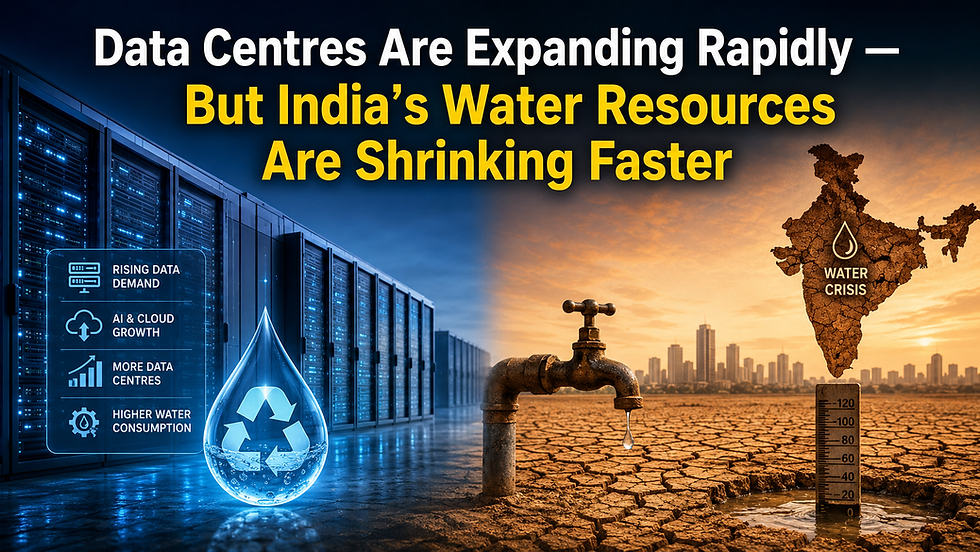
Industrial growth is another major contributor. Manufacturing plants, data centers, pharmaceutical facilities, textile industries, food processing units, commercial complexes, and technology parks require significant quantities of water for their operations.
Agriculture, which remains India's largest water-consuming sector, continues to demand massive volumes of freshwater for irrigation. Traditional irrigation methods often result in substantial water losses, further increasing overall demand.
As living standards improve, per capita water consumption also rises. Modern households use more water for appliances, landscaping, cleaning, and sanitation compared to previous generations.
Why Water Resources Are Under Pressure
While demand continues to rise, water availability is becoming increasingly uncertain.
Groundwater, which supplies a significant portion of India's drinking water needs, is being extracted faster than it can be naturally replenished. Many regions across the country are experiencing declining groundwater levels, forcing communities and industries to drill deeper wells every year. Studies have shown that groundwater stress is particularly severe in several states where extraction exceeds sustainable recharge rates.
Climate change is further complicating the situation. Irregular rainfall patterns, prolonged droughts, extreme weather events, and changing monsoon cycles are making water management more difficult than ever before.
Urban expansion is reducing natural recharge zones. Lakes, wetlands, ponds, and open lands that once helped replenish groundwater are increasingly being replaced by concrete infrastructure.
Water pollution also contributes to scarcity. When rivers, lakes, and groundwater sources become contaminated, the amount of usable freshwater decreases significantly.
The Growing Impact on Cities
Indian cities are already experiencing the consequences of rising water demand.
Many metropolitan regions struggle to provide uninterrupted water supply. During summer months, residents often depend on tanker water due to depleted reservoirs and falling groundwater levels.
Urban populations continue to expand rapidly, placing additional stress on aging water infrastructure. As cities grow vertically and horizontally, demand for water rises across residential, commercial, and industrial sectors.
The challenge is particularly visible in fast-growing technology and industrial hubs where water consumption has increased substantially. Water shortages are becoming a critical planning issue for city administrators and infrastructure developers.
Industries and the Water Challenge
Industries are among the largest consumers of water in modern economies.
Manufacturing, food processing, pharmaceuticals, textiles, chemicals, power generation, and data centers all depend on reliable water supplies. As India's economy expands, industrial water demand is expected to continue rising.
However, industries face growing risks from water scarcity. Insufficient water availability can disrupt production, increase operational costs, and create compliance challenges.
Forward-thinking organizations are increasingly investing in wastewater treatment, recycling systems, and sustainable water management practices. Instead of viewing wastewater as a disposal problem, many industries now recognize it as a valuable resource that can be reused multiple times.
This shift represents one of the most important changes in India's water management landscape.
Agriculture: The Largest Consumer of Water
Agriculture accounts for the majority of India's water consumption.
Traditional flood irrigation methods often lead to excessive water use and significant losses through evaporation and runoff. Water-intensive crops further increase demand in regions that are already water-stressed.
As food requirements grow alongside population growth, agricultural water demand will continue to remain substantial.
Improving irrigation efficiency, adopting micro-irrigation technologies, rainwater harvesting, and treated wastewater reuse can significantly reduce pressure on freshwater resources while maintaining agricultural productivity.
The Untapped Opportunity: Wastewater Recycling
One of the most promising solutions to India's water demand challenge lies in wastewater recycling.
Every day, enormous volumes of wastewater are generated by households, industries, institutions, commercial buildings, and municipalities. Unfortunately, a large portion remains untreated or underutilized.
India generates billions of liters of wastewater daily, yet only a fraction is effectively treated and reused. Experts increasingly view wastewater as a valuable secondary water source capable of reducing dependence on freshwater supplies.
Treated wastewater can be safely reused for:
Landscaping
Industrial cooling
Toilet flushing
Construction activities
Irrigation
Groundwater recharge
Process water applications
By recycling wastewater, organizations can dramatically reduce freshwater consumption while contributing to environmental sustainability.
Why Sewage Treatment Plants Are Becoming Essential
As water demand rises, Sewage Treatment Plants (STPs) are no longer optional infrastructure—they are becoming essential assets.
Modern STPs convert wastewater into reusable water through biological and advanced treatment processes. These systems help organizations reduce freshwater dependency while ensuring environmental compliance.
Residential communities, commercial buildings, educational institutions, hospitals, industrial parks, IT campuses, and manufacturing facilities are increasingly adopting decentralized treatment systems.
A well-designed STP not only protects the environment but also creates a reliable alternative water source that can significantly reduce operational costs over time.
For businesses seeking sustainable wastewater management solutions, a dedicated sewage treatment system can play a crucial role in meeting future water demands.
Learn more about advanced sewage treatment solutions here:
The Role of Technology in Water Sustainability
Technology is transforming the way water is managed.
Smart monitoring systems, IoT-enabled sensors, automated treatment plants, advanced biological treatment technologies, membrane filtration systems, and real-time water quality monitoring are helping organizations maximize efficiency.
Modern wastewater treatment facilities are capable of producing high-quality reusable water while minimizing energy consumption and operational complexity.
As technology continues to evolve, water recycling will become increasingly cost-effective and accessible.
Building a Circular Water Economy
The future of water management lies in creating a circular water economy.
Instead of using freshwater once and discarding wastewater, a circular model focuses on treating, recovering, and reusing water multiple times. This approach reduces pressure on rivers, reservoirs, and groundwater resources while supporting sustainable economic growth.
Several states and cities across India are already promoting treated wastewater reuse policies to address growing water demand and reduce freshwater extraction.
The transition toward circular water management will be critical for ensuring long-term water security.
Conclusion: The Time to Act Is Now
India's rising water demand is one of the defining challenges of the 21st century. Population growth, urbanization, industrial expansion, and climate change are collectively increasing pressure on already stressed water resources.
Freshwater alone cannot meet future demand.
The solution lies in smarter water management, wastewater recycling, rainwater harvesting, efficient irrigation, and widespread adoption of sewage treatment technologies. Every drop of treated wastewater represents an opportunity to reduce freshwater consumption and strengthen water security.
Organizations, industries, institutions, and communities that invest in sustainable water solutions today will be better prepared for the challenges of tomorrow.
The future of India's water security depends not only on how much water we have—but on how wisely we use, treat, and reuse it.


Comments