
Data Centres Are Expanding Rapidly — But India’s Water Resources Are Shrinking Faster

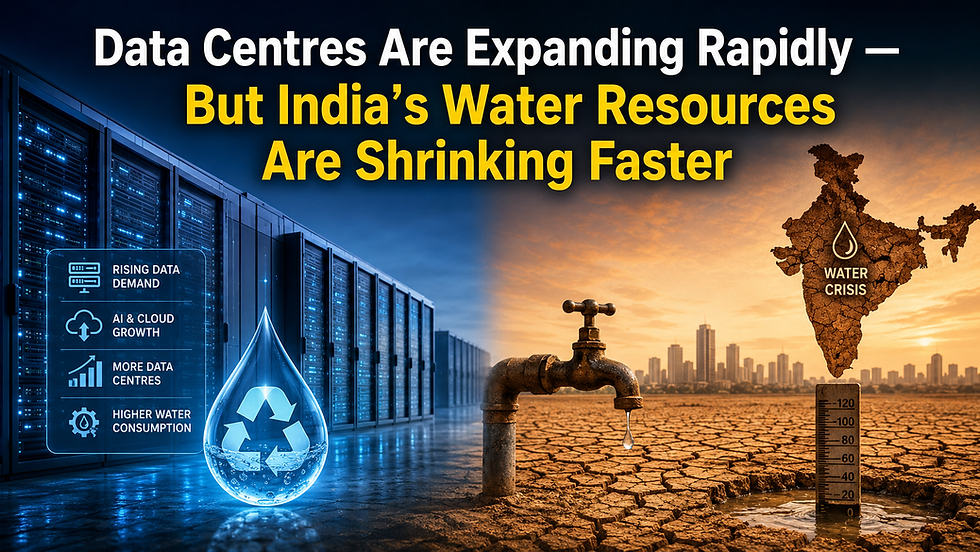
India is witnessing one of the fastest digital infrastructure expansions in its history. Artificial Intelligence, cloud computing, OTT platforms, fintech services, e-commerce, 5G networks, and hyperscale cloud operations are driving an unprecedented demand for data centres across the country. Cities like Bengaluru, Chennai, Hyderabad, Mumbai, Pune, and Delhi NCR are becoming major digital infrastructure hubs.
But beneath this technological revolution lies a growing environmental emergency that most people still do not fully understand — the massive water consumption of modern data centres.
Every search query, every AI request, every video stream, every online transaction, and every cloud-based application ultimately depends on servers that generate enormous amounts of heat. To prevent overheating, data centres require large-scale cooling systems. And these cooling systems consume extraordinary quantities of water every single day.
India is already facing severe water stress. Groundwater levels are falling rapidly. Reservoirs are drying earlier each summer. Urban populations are growing faster than water infrastructure. Climate change is making rainfall unpredictable. Yet at the same time, the country’s digital infrastructure is accelerating at record speed.
The result is a dangerous collision between technological growth and environmental sustainability.
According to industry projections highlighted by BIOSYNK™, India’s data centre sector could require hundreds of billions of litres of water in the coming years if sustainable recycling systems are not adopted quickly.
This is no longer just an environmental issue. It is becoming an economic, industrial, and national infrastructure challenge.
India’s Digital Economy Is Growing Faster Than Ever
India’s digital transformation is creating enormous opportunities. AI-driven industries, cloud storage, fintech ecosystems, smart cities, IoT systems, and digital governance platforms are expanding rapidly across every sector.
Major global technology companies are investing heavily in Indian data centre infrastructure because India offers:
A massive internet user base
Growing AI adoption
Expanding digital payments
Increasing cloud migration
Strong startup ecosystems
Rising enterprise digitization
India’s cumulative data centre capacity has already crossed major milestones and is expected to multiply dramatically over the next decade.
However, while most discussions focus on power consumption and digital growth, very few conversations address the hidden dependency behind every server rack — water.
Why Data Centres Consume So Much Water
Most modern data centres generate enormous heat due to continuous server operations. AI and GPU-based computing facilities produce even higher thermal loads than traditional servers.
To keep systems stable and operational, cooling infrastructure becomes essential.
Many facilities use:
Cooling towers
HVAC systems
Chilled water systems
Evaporative cooling systems
Liquid cooling systems
Heat exchange systems
The biggest issue is that traditional cooling methods waste enormous volumes of freshwater through evaporation.
Industry discussions and infrastructure reports indicate that a large percentage of cooling water can be lost permanently during evaporative processes.
This means millions of litres of freshwater disappear daily simply to maintain server temperatures.
As AI infrastructure grows, water demand increases further because high-density computing environments require stronger cooling systems.
The more India digitizes without sustainable water planning, the greater the pressure on already stressed water resources.
The Hidden Water Crisis Nobody Is Talking About
India is already one of the world’s most water-stressed countries.
Many cities regularly face:
Groundwater depletion
Summer water shortages
Reservoir drying
Tanker dependency
Drought-like conditions
Rising water costs
Poor wastewater management
Cities like Chennai have already experienced severe water crises in recent years.
Bengaluru continues to struggle with groundwater depletion. Hyderabad faces increasing pressure on municipal water infrastructure.
Ironically, many of these same cities are also becoming major data centre hubs.
This creates a dangerous contradiction:
The regions with the highest digital infrastructure growth are often the same regions experiencing worsening water stress.
Without aggressive recycling and reuse systems, future conflicts between industrial demand and public water needs could become unavoidable.
AI Infrastructure Is Accelerating the Problem
Artificial Intelligence is transforming global computing.
AI models require:
Massive GPU clusters
High-density server racks
Continuous processing power
Large-scale cloud infrastructure
Advanced cooling environments
Compared to traditional computing, AI infrastructure generates significantly more heat, increasing cooling requirements dramatically.
As India positions itself as a global AI destination, water demand inside data centres could rise much faster than expected.
The challenge is not just about electricity anymore.
The future battle for sustainable AI infrastructure may ultimately become a battle for water availability.
Why Freshwater Dependency Is a Dangerous Long-Term Strategy
Many facilities still rely heavily on municipal freshwater or groundwater extraction for cooling operations.
This creates several major risks:
1. Rising Operational Costs
Water prices are increasing in many industrial regions. Facilities dependent on freshwater will face continuously rising operational expenses.
2. Regulatory Pressure
Environmental authorities are becoming stricter regarding wastewater discharge, groundwater extraction, and sustainability compliance.
3. ESG Expectations
Global investors increasingly evaluate Environmental, Social, and Governance (ESG) performance. Poor water management can damage corporate sustainability ratings.
4. Climate Uncertainty
Heatwaves, weak monsoons, and drought conditions can disrupt long-term water availability.
5. Public Opposition
Communities facing water shortages may strongly oppose industries perceived as consuming excessive freshwater.
This is why sustainable water infrastructure is no longer optional for future-ready data centres.
It is becoming essential.
The Future Belongs to Water Recycling Infrastructure
The solution is not to stop digital growth.
The solution is to make digital growth sustainable.
Modern data centres must move toward closed-loop water management systems where wastewater is treated, recovered, recycled, and reused continuously.
Instead of depending entirely on freshwater sources, facilities can implement:
Sewage Treatment Plants (STP)
Effluent Treatment Plants (ETP)
Zero Liquid Discharge (ZLD) systems
Greywater recycling
Cooling tower blowdown recovery
RO water treatment systems
Rainwater harvesting systems
Water reuse infrastructure
These technologies allow facilities to dramatically reduce freshwater dependency while improving long-term sustainability.
According to BIOSYNK™, advanced recycling frameworks can reduce freshwater usage significantly while recovering large portions of wastewater for reuse.
Why Closed-Loop Water Systems Are Becoming Critical
Traditional “use and discharge” models are rapidly becoming unsustainable.
Closed-loop systems operate differently:
Freshwater → Treatment → Usage → Recovery → Recycling → Reuse
Instead of wasting water after one cycle, the system continuously treats and recycles it back into operations.
Benefits include:
Lower water consumption
Reduced environmental impact
Better compliance
Lower operating costs
Reduced municipal dependency
Stronger ESG performance
Improved sustainability reporting
This approach is increasingly becoming the future of responsible industrial infrastructure worldwide.
Sustainable Data Centres Will Define the Next Decade
Future-ready data centres will not be judged only by:
Computing capacity
AI performance
Uptime reliability
Cloud scalability
They will also be judged by:
Water efficiency
Wastewater recovery
Environmental sustainability
ESG compliance
Resource optimization
Circular infrastructure models
The companies that invest in sustainable water systems today will become the long-term leaders of tomorrow’s digital economy.
Those that ignore the water crisis may face escalating operational, regulatory, and environmental risks in the future.
Why BIOSYNK™ Is Helping Build Sustainable Data Centre Infrastructure
As India’s digital ecosystem expands, sustainable water management is becoming mission-critical.
BIOSYNK™ Data Centre Water Recycling Solutions India provides advanced integrated wastewater recycling and reuse systems designed specifically for modern data centre infrastructure.
Their solutions include:
Advanced Sewage Treatment Plants
Cooling tower blowdown recycling
Zero Liquid Discharge systems
Industrial RO plants
Greywater recycling systems
Rainwater harvesting systems
Water recovery frameworks
Compliance-ready wastewater management
BIOSYNK™ focuses on helping facilities:
Reduce freshwater dependency
Improve ESG performance
Lower operational costs
Recover wastewater efficiently
Build sustainable cooling infrastructure
Achieve long-term environmental compliance
The company has also been recognized with the FICCI Sustainable Technology Award and focuses on eco-friendly wastewater technologies across industrial and commercial sectors.
India’s Digital Future Cannot Ignore Water Sustainability
India is entering a new era driven by AI, cloud infrastructure, and digital transformation.
But no digital revolution can remain sustainable if it exhausts the country’s most valuable natural resource — water.
The future of data centres cannot depend on unlimited freshwater extraction.
The future must depend on intelligent recycling, circular water systems, sustainable infrastructure planning, and responsible environmental engineering.
India has the opportunity to become not only a global digital powerhouse, but also a global leader in sustainable infrastructure.
The decisions made today will determine whether future growth strengthens the nation — or deepens its environmental crisis.
Because in the coming decade, the real measure of technological progress will not only be how much data we process…
…but how responsibly we protect the water that makes that future possible.


Comments