
Industrial Park Sewage Treatment Plant: The Hidden Engine Driving Profit, Compliance & Sustainability in 2026


Detailed Introduction: The Silent Crisis Inside Industrial Parks
Industrial parks are the backbone of India’s economic growth. From manufacturing hubs to IT corridors, these zones generate massive employment and revenue. But behind this progress lies a critical, often ignored problem — wastewater mismanagement.
Every day, industrial parks generate thousands of liters of sewage from canteens, worker facilities, process units, and utilities. Without proper treatment, this wastewater leads to:
Groundwater contamination
Legal penalties from pollution boards
Operational shutdown risks
Loss of brand reputation
Recent real-world situations show the seriousness — industrial zones without proper treatment systems are facing environmental risks and regulatory pressure due to untreated wastewater discharge.
This is why Industrial Park Sewage Treatment Plants (STPs) are no longer optional — they are a business necessity.
What is an Industrial Park Sewage Treatment Plant?
An Industrial Park STP is a centralized wastewater treatment system designed to handle sewage from multiple industries, worker accommodations, food courts, and utilities.
It treats:
Domestic sewage (toilets, washrooms)
Industrial non-hazardous wastewater
Combined effluent streams
Using biological and advanced filtration processes, it converts wastewater into reusable clean water suitable for:
Cooling towers
Landscaping
Flushing
Industrial reuse
Modern systems can treat 100 KLD to 10,000+ KLD, making them ideal for large industrial clusters.
The Growing Threat of Untreated Wastewater
1. Environmental Damage
Untreated sewage pollutes rivers, lakes, and soil. It destroys ecosystems and affects surrounding communities.
2. Water Scarcity Crisis
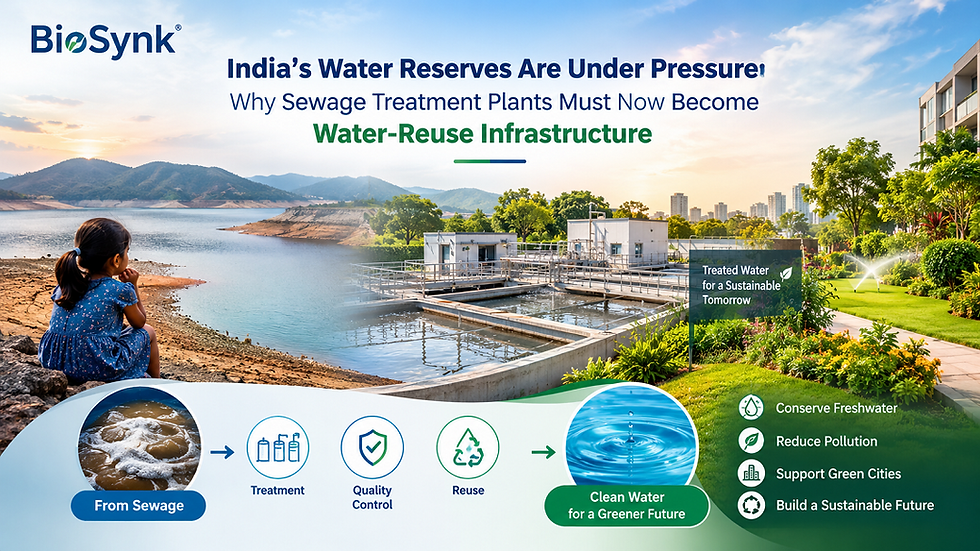
India is already facing water stress. Industrial parks consume massive freshwater daily. Without recycling, this becomes unsustainable.
3. Legal & Compliance Risks
CPCB and State Pollution Control Boards mandate 100% treatment and reuse. Non-compliance leads to fines or closure.
4. Rising Operational Costs
Buying tanker water and paying penalties increases operational expenses significantly.
5. Investor & Brand Impact
Global investors now prioritize ESG (Environmental, Social, Governance). Poor wastewater management reduces credibility.
Why STPs Are Mandatory for Industrial Parks in 2026
1. Strict Pollution Control Norms
Government regulations are becoming stricter every year. Industrial parks must meet discharge standards like:
BOD < 10 mg/L
COD < 50 mg/L
TSS < 10 mg/L
2. Zero Liquid Discharge (ZLD) Trend
Modern industries aim for zero discharge, meaning every drop is reused.
3. Water Reuse is the Future
Authorities are now promoting reuse of treated water for industries and agriculture.
4. Sustainability Certifications
Green certifications like LEED & IGBC require proper wastewater treatment.
How Industrial STP Works (Step-by-Step)
Collection & Screening – Removes large solids
Equalization Tank – Balances flow
Biological Treatment – Microorganisms break down pollutants
Aeration Process – Oxygen enhances treatment
Clarification – Settles sludge
Filtration (PSF & ACF) – Removes fine particles
Disinfection (UV/Chlorine) – Kills pathogens
Reuse Storage – Clean water ready for reuse
This multi-stage system ensures water meets CPCB standards for reuse.
Top 9 Benefits of Installing an Industrial Park STP
1. Massive Cost Savings
Industrial parks can save lakhs annually by reducing tanker water dependency and lowering operational costs.
2. Up to 80–90% Water Reuse
Modern STPs allow reuse of most wastewater, reducing freshwater consumption drastically.
3. Compliance Without Stress
Avoid penalties, shutdowns, and legal complications.
4. Eco-Friendly Operations
Reduces pollution and supports sustainable development.
5. Space Optimization
Underground STPs allow land use for parking or landscaping.
6. Odour-Free Environment
Advanced systems eliminate foul smell completely.
7. Low Maintenance
New-age systems reduce sludge and eliminate chemical dependency.
8. Scalable Design
Easily expandable as your industrial park grows.
9. Strong ROI
Savings + compliance + sustainability = long-term profit growth.
Common Questions Industrial Owners Ask (Solved)
❓ Is STP mandatory for industrial parks?
Yes. CPCB and SPCB require wastewater treatment before discharge or reuse.
❓ What capacity do I need?
Depends on workforce and operations — typically 100 KLD to 10,000 KLD.
❓ Can treated water be reused?
Yes, for cooling, flushing, gardening, and industrial use.
❓ Is maintenance expensive?
Modern Bio STPs reduce maintenance by up to 85%.
❓ Will it smell or take space?
No. Advanced systems are odour-free and underground.
❓ How long does installation take?
Typically 4–12 weeks depending on capacity and site conditions.
Why Industrial Parks Are Losing Money Without STP
Without a proper system:
You buy expensive water daily
You pay penalties
You lose ESG credibility
You risk shutdown
But with STP:
Wastewater becomes a resource
Costs turn into savings
Compliance becomes automatic
Why Choose Bio Synk – The Smart Industrial Solution
At Bio Synk, we don’t just install STPs — we deliver complete wastewater transformation systems.
Our Strengths:
✅ 100–10,000+ KLD customized solutions
✅ Up to 85% maintenance cost savings
✅ 100% water reuse capability
✅ Odour-free, underground design
✅ Smart automation & monitoring
✅ CPCB & SPCB compliant systems
✅ 15+ years of expertise
What Makes Us Different?
No daily chemicals
Minimal manpower
Long-lasting systems
Designed for industrial scale
Let’s Build a Cleaner, Profitable Industrial Future
The future of industrial parks is not just about production — it’s about sustainability, efficiency, and responsibility.
If your industrial park is still:
Spending heavily on water
Struggling with compliance
Facing environmental risks
Then the time to act is now.
🚀 Get Your Industrial Park STP Today
Transform your wastewater into profit, compliance, and sustainability with Bio Synk.


Comments