
India Cannot Build Smart Cities While Rivers Continue Carrying Untreated Sewage


India’s Smart City Dream Has a Dangerous Blind Spot
Across India, cities are expanding faster than ever before. Flyovers are rising, metro lines are stretching across urban landscapes, IT parks are multiplying, and smart infrastructure projects are becoming symbols of economic progress. From Bengaluru to Chennai, Hyderabad to Pune, India is entering a new era of urban transformation.
But beneath this modern development lies a silent environmental crisis that continues to grow every single day — untreated sewage entering rivers, lakes, groundwater systems, and public water bodies.
A city cannot truly become “smart” while its rivers carry black wastewater instead of flowing freshwater.
This is the contradiction India now faces.
Urban development is accelerating, but wastewater infrastructure is struggling to keep pace. Millions of liters of untreated sewage continue flowing into rivers daily, affecting ecosystems, drinking water sources, agriculture, biodiversity, and public health. Even after large-scale river rejuvenation projects and government cleanup missions, pollution levels in many urban rivers remain critically high.
The truth is becoming impossible to ignore:
Without advanced sewage treatment infrastructure, the vision of sustainable smart cities will remain incomplete.
The Growing Urban Sewage Crisis in India
India generates enormous quantities of sewage every day due to rapid urbanization, industrial expansion, commercial construction, apartment developments, hospitals, hotels, educational institutions, and growing residential populations.
However, sewage treatment capacity in many regions remains insufficient.
As cities grow vertically and horizontally, wastewater generation rises dramatically. Unfortunately, drainage systems, underground sewer networks, and treatment facilities are often outdated, overloaded, or entirely absent in developing urban areas.
The result is devastating:
Untreated sewage entering rivers
Contaminated lakes and reservoirs
Groundwater pollution
Toxic urban drains
Declining oxygen levels in rivers
Fish and aquatic ecosystem destruction
Severe public health risks
Increasing water scarcity
Many rivers flowing through Indian cities now carry more sewage than natural freshwater flow during dry seasons.
This transforms living rivers into moving wastewater channels.
Why Smart Cities Cannot Ignore Sewage Treatment Anymore
A smart city is not defined only by digital infrastructure, AI traffic systems, surveillance technology, or modern buildings.
A truly smart city must also protect:
Water resources
Environmental sustainability
Public health
Wastewater management
Circular water reuse systems
Ecological balance
Without sewage treatment, urban growth becomes environmentally destructive.
Modern cities consume massive amounts of water every day. But very few cities recycle wastewater effectively. Instead, used water is discharged into nearby rivers and lakes, creating long-term ecological collapse.
This creates a dangerous cycle:
Freshwater sources become polluted
Groundwater quality declines
Water treatment costs rise
Cities face water shortages
Public health expenses increase
Environmental restoration becomes extremely expensive
Eventually, cities begin running out of usable water.
This is exactly why sewage treatment plants are becoming essential infrastructure for future urban development.
Rivers Are Paying the Price of Urban Expansion
India’s rivers have historically been centers of civilization, spirituality, agriculture, and biodiversity. But rapid urbanization has placed enormous pressure on these ecosystems.
Today, many rivers passing through cities suffer from:
Sewage inflow
Industrial discharge
Plastic accumulation
Sludge deposits
Low dissolved oxygen
Foam formation
Algae blooms
Toxic contamination
When untreated sewage enters rivers continuously, oxygen levels fall drastically.
Aquatic organisms struggle to survive. River ecosystems collapse slowly over time.
This affects:
Fish populations
Agricultural irrigation
Drinking water safety
Livelihoods
Tourism
Religious and cultural activities
Even advanced river restoration projects cannot succeed unless sewage inflow is controlled at the source.
That is why environmental experts increasingly emphasize decentralized sewage treatment systems, bio-STPs, and sustainable wastewater recycling technologies.
Government Policies Are Becoming Stricter
Across India, pollution control authorities and urban development agencies are tightening environmental regulations related to wastewater discharge and sewage management.
Authorities are increasingly focusing on:
Sustainable wastewater treatment
River restoration
Lake rejuvenation
Water reuse systems
Environmental compliance
Zero liquid discharge goals
Decentralized treatment infrastructure
Smart urban water management
Many new construction approvals now require proper sewage treatment systems.
Residential apartments, commercial complexes, hotels, hospitals, industries, institutions, and townships are under increasing pressure to install efficient STPs.
This shift is not temporary.
It reflects a long-term transformation in how India approaches urban sustainability and water security.
Why Treated Wastewater Is Becoming the Future of Water Management
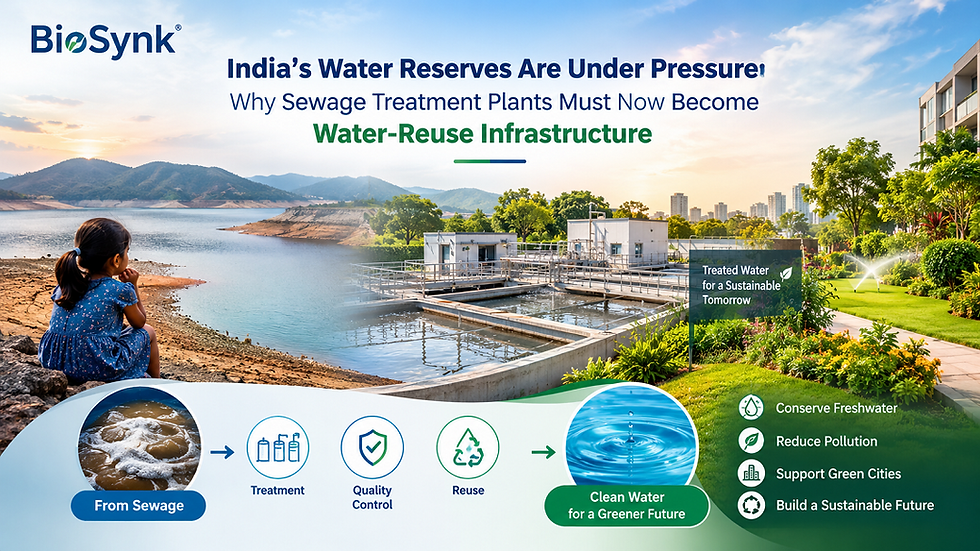
India is entering an era where wastewater recycling is no longer optional.
It is becoming essential.
Cities cannot rely only on groundwater extraction and freshwater reservoirs forever. Climate uncertainty, population growth, and urban expansion are creating enormous pressure on available water resources.
Treated wastewater offers a sustainable alternative.
Modern sewage treatment plants can help recycle wastewater for:
Landscaping
Flushing systems
Gardening
Cooling applications
Industrial reuse
Construction activities
Irrigation
This reduces freshwater dependency significantly.
Wastewater is no longer viewed only as waste.
It is increasingly becoming a recoverable water resource.
The Rise of Bio STPs in Sustainable Urban Infrastructure
Traditional sewage treatment systems often require:
Large spaces
High maintenance
Heavy chemical usage
Complex operations
Significant energy consumption
Modern Bio STPs are changing this approach.
Bio-based sewage treatment technologies focus on:
Eco-friendly treatment processes
Reduced sludge generation
Efficient wastewater recycling
Lower operational costs
Sustainable environmental performance
They are increasingly being adopted across:
Residential apartments
Commercial buildings
Industrial facilities
Hotels and resorts
Educational campuses
Healthcare institutions
Smart township projects
As India moves toward environmentally responsible urban development, Bio STPs are becoming critical infrastructure solutions.
Environmental Responsibility Is No Longer a Choice
Businesses, industries, builders, and institutions can no longer treat wastewater management as a secondary concern.
Environmental responsibility now directly impacts:
Regulatory approvals
Public reputation
Operational sustainability
Water security
Future compliance requirements
Long-term cost efficiency
Consumers and communities are also becoming more environmentally aware.
People increasingly expect modern developments to include sustainable wastewater management systems.
This shift is redefining urban infrastructure standards across India.
India’s Future Depends on Water Sustainability
The future of India’s cities depends not only on economic growth but also on environmental resilience.
No city can thrive while:
Rivers remain polluted
Lakes disappear
Groundwater becomes toxic
Freshwater scarcity increases
Wastewater flows untreated into ecosystems
The cities that succeed in the future will be the ones that:
Recycle water efficiently
Invest in sustainable infrastructure
Protect natural water bodies
Treat sewage responsibly
Build circular water economies
Smart cities must become water-smart cities.
Without sewage treatment, there is no true urban sustainability.
Why Businesses and Residential Projects Must Act Now
Every new building project, industrial operation, commercial complex, and residential development creates wastewater.
Ignoring sewage treatment today creates:
Environmental damage
Regulatory risks
Water scarcity challenges
Public health concerns
Higher long-term operational costs
Installing a reliable sewage treatment plant is no longer just about compliance.
It is about future-proofing infrastructure.
Organizations that adopt sustainable wastewater solutions today will be better prepared for tomorrow’s environmental and regulatory landscape.
Build a Cleaner and Smarter Future With Bio Synk
At Bio Synk, we believe India’s smart city future must be built on sustainable water management and responsible sewage treatment infrastructure.
We provide advanced, eco-friendly sewage treatment solutions designed for:
Residential apartments
Commercial complexes
Hotels and resorts
Industrial facilities
Institutions and campuses
Smart township developments
Our solutions focus on:
Efficient wastewater treatment
Sustainable water reuse
Reduced environmental impact
Reliable long-term performance
Modern Bio STP technology
As environmental regulations become stricter and water conservation becomes more important than ever, investing in the right sewage treatment system is a critical step toward sustainable growth.
Learn more about our advanced sewage treatment solutions here:
Together, we can help create cleaner rivers, healthier cities, sustainable infrastructure, and a smarter environmental future for India.


Comments