
Gurugram to Build New 100 MLD Sewage Treatment Plant: Why India’s Cities Must Stop Untreated Wastewater from Reaching Rivers


India’s cities are growing faster than ever.
New apartments are being built. New roads and commercial areas are expanding. Industrial and business activity is increasing. More people are moving into urban areas every year.
But there is another side to this growth that often receives less attention:
More people and more development also mean more wastewater.
Every day, homes, apartments, offices, hotels, hospitals, schools, colleges, shopping centres and industries generate sewage and wastewater. If that wastewater is not properly collected, treated and managed, it can eventually reach drains, lakes, rivers and other water bodies.
A major development in Gurugram, Haryana, has once again highlighted why wastewater treatment infrastructure is becoming so important.
The Gurugram Metropolitan Development Authority (GMDA) is planning a 100 MLD (Million Litres per Day) Sewage Treatment Plant in Sector 107, along with a 400 MLD main pumping station. The project is intended to address sewage generated in Sectors 81 to 115 and help prevent untreated sewage from flowing through the Najafgarh drain toward the Yamuna.
The reported project cost is around ₹197 crore, with the STP planned on approximately 49 acres. Officials have said the plant will use Sequential Batch Reactor (SBR) technology, and the project is also expected to generate power. The tender has been floated, with work expected to be awarded within the stated timeline.
This is not only a Gurugram story.
It is a warning and a lesson for cities across India.
If cities grow, sewage treatment capacity must grow with them.
Gurugram’s New 100 MLD STP: Why This News Matters
The proposed 100 MLD STP in Sector 107 is significant because it connects several important wastewater-management challenges in one project:
Urban expansion
Increasing sewage generation
Sewerage infrastructure
Pumping capacity
Wastewater treatment
Water pollution prevention
Treated-water management
River protection
Resource recovery
The project is planned to treat sewage generated from sectors 81 to 115. According to the latest report, Gurugram currently has around 433 MLD of installed sewage-treatment capacity, while the city has plans to add substantially more capacity through new STPs.
This highlights an important reality:
A city cannot depend on yesterday’s wastewater infrastructure to manage tomorrow’s population.
As residential communities and commercial developments expand, wastewater infrastructure must be upgraded at the same time.
What Does 100 MLD Mean?
The term MLD stands for Million Litres per Day.
Therefore:
1 MLD = 1 million litres per day
A 100 MLD sewage treatment plant is designed for a treatment capacity of:
100 million litres of sewage per day
That is a huge volume of wastewater.
To put it simply, the project represents infrastructure designed to manage an enormous quantity of sewage generated by a rapidly developing urban area.
But the important point is not only the number.
The important point is what happens to those millions of litres of wastewater.
Without proper treatment, wastewater can become a pollution problem.
With appropriate treatment and reuse, wastewater can become a potential resource.
Why Untreated Sewage Reaching Rivers Is a Serious Problem
Rivers are essential sources of water, ecosystems and livelihoods.
But rivers can be placed under enormous pressure when untreated sewage enters them.
Domestic sewage can contain:
Organic matter
Suspended solids
Nutrients
Microorganisms
Detergents
Other contaminants
When untreated sewage enters a river or water body, it can affect water quality and aquatic ecosystems.
The Gurugram project is particularly relevant because officials have said its objective includes reducing pollution reaching the Najafgarh drain and subsequently the Yamuna.
This shows why sewage treatment is not simply about keeping a building or neighbourhood clean.
It is about protecting the wider environment.
The Real Wastewater Journey Begins After You Flush
Most people rarely think about what happens after they flush a toilet.
The wastewater leaves the building.
It enters a drainage or sewer network.
From there, it must be transported somewhere.
Ideally, the journey should look like this:
Toilet / Household → Sewer Network → Pumping System → STP → Treatment → Reuse or Compliant Discharge
But if any part of the system is missing or inadequate, untreated wastewater can create problems.
This is why a sewage treatment plant cannot be considered separately from sewer networks and pumping infrastructure.
All parts of the wastewater system need to work together.
Why the 400 MLD Pumping Station Is Also Important
The Gurugram project includes not only a 100 MLD STP but also a 400 MLD main pumping station.
Why is this important?
Because sewage has to reach the treatment plant.
A treatment plant cannot treat wastewater that never arrives at the facility.
Pumping stations can therefore play an important role in transporting sewage through the sewerage network, especially where gravity flow alone is insufficient.
This gives us an important lesson:
Wastewater management requires a complete system.
It is not just:
Build an STP.
It is:
Collect → Convey → Pump where required → Treat → Monitor → Reuse or Discharge
Every stage matters.
Why Cities Must Build STPs Before the Problem Gets Worse
One of the biggest mistakes cities can make is waiting until wastewater pollution becomes severe before expanding treatment infrastructure.
By that time, the environmental and financial costs may already be significant.
A better strategy is to plan wastewater infrastructure ahead of urban growth.
For example, if a new residential area is expected to add tens of thousands of residents, authorities and developers should ask:
How much water will the area consume?
How much sewage will it generate?
Where will the sewage go?
Is sewer capacity sufficient?
Is pumping infrastructure adequate?
Is there enough STP capacity?
Can treated wastewater be reused?
These questions should be addressed before wastewater becomes a crisis.
Urbanisation Means More Wastewater
India’s cities are expanding rapidly.
Consider a new residential development.
It may include:
500 apartments
1,000 apartments
2,000 apartments
5,000 apartments
Every resident uses water.
Water used for bathing, toilets, washing, cleaning and other activities eventually creates wastewater.
Now imagine thousands of apartments across a city.
The volume becomes enormous.
Then add:
Hotels
Hospitals
Schools
Colleges
Offices
IT parks
Restaurants
Shopping malls
Industrial facilities
The result is a huge urban wastewater stream.
This is why wastewater treatment must be planned as core city infrastructure.
Sewage Treatment Is Not Just About Pollution Control
Sewage treatment is often described as an environmental-protection measure.
That is true.
But there is another equally important side:
Water conservation.
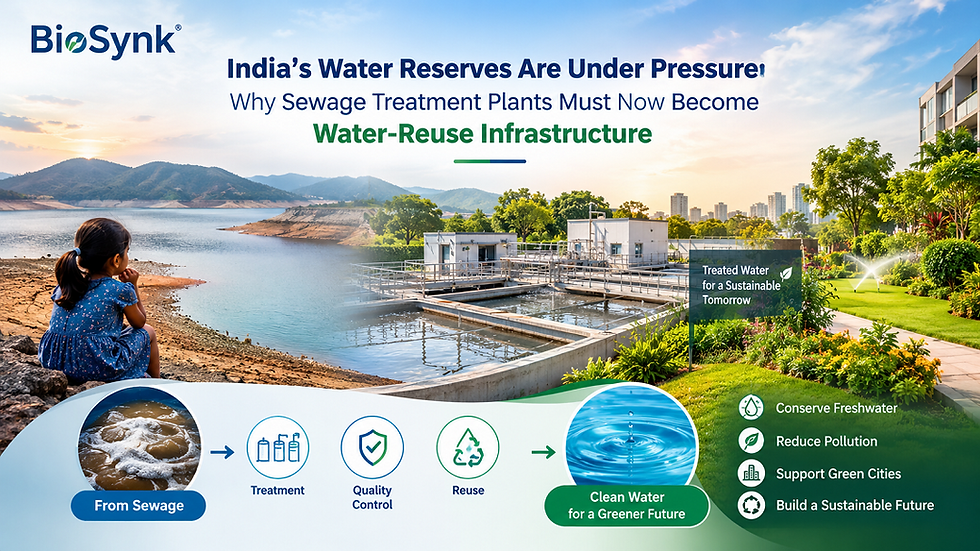
When wastewater is treated to an appropriate quality, it may be possible to reuse it for suitable non-potable applications, subject to technical requirements and applicable regulations.
Instead of:
Freshwater → Use → Wastewater → Discharge
we can move toward:
Freshwater → Use → Wastewater → Treatment → Reuse
This is a circular approach to water management.
What Can Treated Wastewater Be Used For?
The exact reuse options depend on the treated-water quality and applicable requirements.
Potential non-potable applications can include:
Landscaping
Treated wastewater can potentially be reused for gardens and landscaping where permitted.
Toilet Flushing
Suitable recycled water can reduce freshwater consumption for flushing.
Road and Area Cleaning
Certain non-potable cleaning activities may use appropriately treated water.
Construction
Treated water may be suitable for selected construction-related uses where quality requirements permit.
Industrial Applications
Some industries can reuse appropriately treated wastewater for selected processes or utility applications.
Other Non-Potable Uses
Project-specific applications can be considered based on technical feasibility and regulations.
The objective should always be:
Treat properly → Test appropriately → Reuse safely.
Gurugram’s Project Highlights the Importance of SBR Technology
The proposed Gurugram STP is reported to use Sequential Batch Reactor (SBR) technology.
SBR is a biological wastewater-treatment process in which different treatment stages occur sequentially within a reactor system.
A typical cycle can include:
Fill
React
Settle
Decant
Idle
During the biological treatment stage, microorganisms help break down biodegradable organic matter.
One advantage of a batch-based approach is that several biological treatment functions can be integrated into a controlled sequence.
However, no technology should be selected simply because it is popular.
The right STP technology depends on:
Wastewater characteristics
Flow
Capacity
Land availability
Required treated-water quality
Energy requirements
Automation needs
Sludge management
Reuse objectives
Site conditions
Operation and maintenance requirements
A good STP begins with good engineering.
Every Project Does Not Need a 100 MLD STP
The Gurugram project is a municipal-scale wastewater project.
But this does not mean every property needs a 100 MLD plant.
Different developments have different wastewater requirements.
A small residential project may require a smaller STP.
A large gated community may require a medium-capacity system.
A hospital may require a specialised wastewater-management approach.
A hotel may require treatment based on its occupancy and water usage.
An industrial facility may need both domestic sewage treatment and a separate ETP for process effluent.
Therefore:
STP capacity must be based on actual wastewater generation.
Why Apartments Need Proper Sewage Treatment
Large residential developments are becoming common across India's cities.
An apartment complex can generate wastewater from:
Toilets
Bathrooms
Kitchens
Washing
Cleaning
Clubhouses
Common facilities
Staff areas
The STP should be planned according to expected occupancy and wastewater generation.
Apartment associations should also consider what happens after treatment.
Can the treated water be used for:
Landscaping?
Gardening?
Toilet flushing?
Other approved non-potable applications?
A well-planned STP can become part of a community's water-conservation strategy.
Hospitals Need Reliable Wastewater Management
Hospitals cannot afford to treat wastewater as an afterthought.
Healthcare facilities generate wastewater through:
Patient rooms
Toilets
Bathrooms
Kitchens
Laundry
Laboratories
Staff facilities
Other hospital operations
The characteristics of hospital wastewater can vary, so the treatment system should be selected based on the actual wastewater profile and applicable requirements.
Important considerations include:
Proper treatment
Biological processes
Disinfection
Monitoring
Sludge management
Safe discharge or reuse
A hospital needs a wastewater system that is designed for its actual requirements.
Hotels and Resorts Can Save Freshwater Through Reuse
Hotels consume large quantities of water every day.
Guests use water.
Restaurants use water.
Laundry uses water.
Housekeeping uses water.
Gardens use water.
This creates significant wastewater.
An appropriate STP can treat wastewater generated by the property.
Where permitted, treated water can potentially be reused for landscaping, flushing and other non-potable purposes.
This can reduce reliance on freshwater and support a hotel's sustainability objectives.
Schools and Colleges Should Think Beyond Sewage Disposal
Educational campuses have an opportunity to become examples of responsible water management.
Schools and colleges can use suitable STPs to treat wastewater from:
Student facilities
Toilets
Hostels
Kitchens
Staff facilities
Other campus operations
The treated water may potentially be reused for landscaping or other approved applications.
This also creates an opportunity to teach students a practical lesson:
Water does not have to be used only once.
Commercial Buildings Are Part of the Solution
Office buildings, IT parks, shopping centres and other commercial developments generate substantial wastewater.
Their wastewater comes from:
Employees
Visitors
Toilets
Cafeterias
Kitchens
Cleaning
Maintenance
A properly designed STP can help these properties manage wastewater responsibly.
Treated-water reuse can also reduce freshwater demand for appropriate non-potable applications.
Industrial Facilities Need to Understand STP vs ETP
One of the most important points for industries is that sewage and industrial effluent are not necessarily the same thing.
STP
An STP is generally intended for domestic sewage.
ETP
An ETP is designed for industrial effluent and process wastewater, depending on the nature of the industry.
For example, a manufacturing facility may have:
Domestic sewage → STP
and
Process wastewater → ETP / specialised treatment
The exact treatment system depends on the contaminants present.
Industries should therefore assess each wastewater stream before selecting a treatment technology.
Underground RCC STPs Can Help Solve Urban Space Problems
Land is expensive in many Indian cities.
A property may need to accommodate:
Buildings
Roads
Parking
Gardens
Play areas
Utility systems
Fire-safety infrastructure
Sewage treatment
This creates a major design challenge.
For suitable projects, an underground RCC sewage treatment plant can help keep the primary treatment tanks below ground level.
The surface area can then potentially be used for:
Landscaping
Parking
Roads
Open areas
Other planned facilities
Appropriate access points and manholes can be provided for inspection and maintenance.
However, underground RCC STPs require proper engineering.
Important considerations include:
Structural design
Soil conditions
Groundwater
Waterproofing
Buoyancy
Ventilation
Access
Maintenance
RCC construction quality
Site loading conditions
An underground STP should therefore be planned as an engineered system, not simply as an underground tank.
Why Proper STP Design Matters
Two projects can have the same population but completely different wastewater characteristics.
For example:
An apartment community may generate primarily domestic sewage.
A hotel may have kitchen and laundry wastewater.
A hospital may have more complex wastewater characteristics.
An industrial facility may have separate domestic sewage and process effluent.
Therefore, STP design should consider:
Wastewater Quantity
How much wastewater is generated daily?
Peak Flow
What happens during periods of maximum wastewater generation?
Wastewater Quality
What contaminants are present?
Treatment Target
What quality is required after treatment?
Reuse
Where will the treated water be used?
Space
How much land is available?
Future Expansion
Will the project grow?
Operation
How will the system be managed?
These factors should be evaluated before selecting the final system.
The Importance of Treated-Water Quality
Not all treated water is automatically suitable for every reuse application.
The required quality depends on the intended use and applicable standards.
For example, the requirements for water used in:
Landscaping
Toilet flushing
Industrial processes
Construction
Discharge
may differ.
Therefore, the treatment process should be designed around the final use of the treated water.
This is why wastewater treatment and water reuse should be planned together.
What Happens If We Do Not Reuse Treated Wastewater?
Imagine a large apartment complex.
Freshwater is brought into the property.
Residents use it.
Wastewater is generated.
The wastewater is treated.
Then the treated water is discharged away.
The apartment complex continues buying freshwater for landscaping and flushing.
This is a missed opportunity.
If suitable treated wastewater can safely replace freshwater for certain non-potable uses, the property can potentially reduce freshwater demand.
This is the basic principle behind water recycling.
Wastewater Can Become a Resource
The future of wastewater management should not be based only on disposal.
It should focus increasingly on:
Treatment
Recycling
Reuse
Resource recovery
Water conservation
This is especially important in cities where freshwater resources are under pressure.
Instead of asking:
“How do we get rid of sewage?”
we should ask:
“How can we safely treat and recover value from sewage?”
That is a much more sustainable question.
The Power Generation Angle Is Also Important
The latest Gurugram report states that the proposed plant is expected to generate power, with officials indicating that the project will use gas generated at the plant for local electricity generation.
This is an important reminder that wastewater treatment can potentially involve resource recovery, not simply pollution removal.
Wastewater treatment facilities can sometimes recover resources from organic matter and sludge through suitable processes.
Depending on the technology and project design, recovered energy can potentially help offset some operational energy requirements.
This demonstrates how wastewater treatment is evolving.
It is no longer only about:
“Clean the wastewater and discharge it.”
It can increasingly involve:
“Treat wastewater, recover resources and reuse water.”
Cities Need Complete Wastewater Infrastructure
A city cannot solve wastewater pollution with STPs alone.
It needs an entire ecosystem.
1. Sewer Networks
Wastewater must be collected.
2. Pumping Stations
Wastewater must be moved where gravity flow is insufficient.
3. Sewage Treatment Plants
Wastewater must be treated.
4. Monitoring
Treatment performance needs to be checked.
5. Sludge Management
Sludge must be managed appropriately.
6. Treated-Water Reuse
Suitable treated water should be considered for beneficial reuse.
7. Public Awareness
People need to understand responsible wastewater practices.
The Gurugram project is a good example of how several components — STP and pumping infrastructure — can be planned together.
Why India Needs More Decentralised STPs Too
Large city-level STPs are essential.
But decentralised wastewater treatment also has an important role.
Consider:
Apartments
Gated communities
Hotels
Hospitals
Schools
Colleges
IT parks
Industrial campuses
Commercial complexes
Each property can manage its wastewater locally with an appropriately sized treatment system.
This reduces dependence on a single central facility and can provide opportunities for local treated-water reuse.
Decentralised treatment can therefore complement large municipal infrastructure.
Why Developers Should Plan STPs Before Construction
Wastewater treatment should not be added at the last moment.
Developers should consider wastewater management during the initial project planning.
A good planning process should include:
Step 1: Estimate population
Step 2: Estimate water consumption
Step 3: Calculate expected wastewater generation
Step 4: Consider peak flow
Step 5: Plan future expansion
Step 6: Select suitable treatment technology
Step 7: Decide above-ground or underground installation
Step 8: Plan treated-water reuse
Step 9: Plan maintenance access
Step 10: Consider applicable requirements
This approach helps create a more practical long-term wastewater solution.
How Residents Can Help Prevent Wastewater Pollution
Wastewater management begins before sewage reaches the STP.
Residents can help by:
Not throwing plastic into toilets
Avoiding solid waste entering drains
Not pouring oils into sinks
Avoiding harmful chemicals entering wastewater systems
Reducing unnecessary water wastage
Reporting sewage leaks
Supporting proper STP maintenance
Encouraging safe water reuse
The treatment plant is only one part of the system.
Good wastewater management begins at the source.
Why Every Growing City Should Learn From Gurugram
The Gurugram project sends a clear message.
When cities grow, wastewater infrastructure must grow with them.
The proposed 100 MLD STP is designed to serve wastewater generated from a large group of sectors, while the associated pumping infrastructure is intended to move sewage efficiently through the network.
Other growing cities should ask the same questions:
Do we have enough STP capacity?
Are our sewer networks sufficient?
Can our pumping stations handle future demand?
Are we preventing untreated sewage from entering water bodies?
Are we reusing treated water wherever appropriate?
Are our existing STPs properly operated and maintained?
These questions are not only relevant to Gurugram.
They are relevant to Bengaluru, Chennai, Hyderabad, Mumbai, Pune, Delhi-NCR, Ahmedabad, Coimbatore, Kochi and every rapidly developing Indian city.
The Future of Urban Water Management Is Circular
India's water strategy cannot depend entirely on continuously finding new freshwater sources.
A more sustainable approach is to use water more than once where technically and legally appropriate.
The circular water model looks like this:
Freshwater
↓
Responsible Water Use
↓
Wastewater Generation
↓
Sewage Treatment
↓
Quality Monitoring
↓
Treated-Water Reuse
↓
Reduced Freshwater Demand
This is the direction in which modern wastewater management needs to move.
Why STP Maintenance Is as Important as STP Construction
A new sewage treatment plant is only useful when it performs properly.
Even a well-designed STP can face problems if it is not operated and maintained correctly.
Regular attention may be required for:
Pumps
Blowers
Motors
Screens
Biological processes
Valves
Electrical systems
Sensors
Filters
Disinfection systems
Sludge handling
The treatment process should also be monitored to ensure that the system performs according to its design and applicable requirements.
Therefore:
STP installation is the beginning, not the end, of wastewater management.
What Makes a Smart Sewage Treatment Plant?
A smart STP should be designed around the actual needs of the project.
It should consider:
Efficient Treatment
The treatment process should be suitable for the wastewater.
Appropriate Capacity
The system should match expected wastewater generation.
Water Reuse
Where feasible, treated water should be considered as a resource.
Space Optimisation
Underground RCC solutions can be considered for suitable sites.
Automation
Automation can help improve operational control where appropriate.
Monitoring
Regular monitoring supports reliable operation.
Maintainability
Equipment and treatment areas should remain accessible for servicing.
Sustainability
The system should support long-term water and environmental goals.
Gurugram’s 100 MLD Project Is Bigger Than One City
The significance of this news goes beyond Gurugram.
India is developing rapidly.
With development comes wastewater.
With wastewater comes responsibility.
Cities must ensure that wastewater is collected, treated and managed before it can damage rivers and other water resources.
The proposed 100 MLD plant is therefore a useful example of what cities need to consider as urban areas expand.
The message is simple:
Urban development without wastewater management is not sustainable development.
The Time to Plan Wastewater Treatment Is Now
Whether you are developing:
An apartment project
A gated community
A villa project
A hospital
A hotel
A school
A college
An IT park
A commercial complex
An industrial facility
wastewater treatment should be considered from the beginning.
Do not wait until sewage becomes a problem.
Plan the treatment system before the problem occurs.
Think about capacity.
Think about treated-water reuse.
Think about land.
Think about underground RCC construction where appropriate.
Think about maintenance.
Think about long-term sustainability.
Final Thoughts: Stop Treating Rivers as Wastewater Destinations
The news of Gurugram planning a new 100 MLD sewage treatment plant is a reminder of something every Indian city needs to understand:
Rivers are not drains.
Untreated sewage should not become the responsibility of the next water body downstream.
Wastewater needs to be collected.
It needs to be transported.
It needs to be treated.
And where technically feasible and permitted, treated water should be reused.
The proposed Gurugram project, together with its pumping infrastructure, demonstrates the scale of investment required to manage wastewater in rapidly growing urban areas.
But government infrastructure alone cannot solve India's wastewater challenge.
Every apartment.
Every hotel.
Every hospital.
Every school.
Every commercial building.
Every industrial facility.
Every institution.
Every community.
All have a role to play.
The future should not be:
Use Water → Create Sewage → Pollute Rivers
It should be:
Use Water → Treat Wastewater → Reuse Water → Protect Rivers
That is the smarter way forward.
Need a Sewage Treatment Plant for Your Project?
If your project generates domestic sewage and you are looking for a reliable sewage treatment plant solution, the right system should be selected based on wastewater generation, capacity, site conditions, treatment requirements, treated-water reuse goals and applicable requirements.
Bio Synk offers sewage treatment plant solutions for residential, commercial, institutional and other suitable applications.
For projects where land utilisation is important, underground RCC sewage treatment plant solutions can be considered where technically suitable. The main treatment tanks can be located underground with appropriate manholes and access provisions, helping preserve valuable surface space for landscaping, parking and other project requirements.
A properly planned STP can help your project work toward:
Responsible sewage treatment
Better wastewater management
Treated-water reuse
Reduced freshwater demand for suitable applications
Sustainable development
Efficient use of available land
Explore Sewage Treatment Plant Solutions
Treat wastewater. Reuse water. Protect rivers. Build a cleaner and more sustainable future.


Comments