
Delhi Plans 4 New Sewage Treatment Plants: Why India’s Cities Must Accelerate Wastewater Treatment and Water Reuse


Delhi’s wastewater management plans have received fresh attention as the Delhi Jal Board (DJB) informed the National Green Tribunal (NGT) that the tender process for four proposed sewage treatment plants is expected to be completed within two months.
The proposed sewage treatment plants are planned at Fatehpur Beri, Ghitorni, Asola and Rangpuri to address wastewater treatment requirements in the Vasant Kunj catchment and nearby areas. According to the latest status submitted by the DJB, the tenders are currently under technical evaluation.
The development is another reminder that India’s rapidly growing cities cannot afford to treat wastewater management as an afterthought. As urban populations, residential communities, commercial developments, hospitals, institutions and industrial facilities continue to grow, the amount of sewage generated every day also increases.
The real question is no longer simply where wastewater goes.
The bigger question is:
Is wastewater being properly treated, safely managed and reused?
Four New STPs Highlight the Growing Need for Better Wastewater Management
The four proposed Delhi sewage treatment plants are part of efforts to improve wastewater treatment infrastructure around the Vasant Kunj catchment.
The DJB has indicated that the tender process is expected to be completed within two months. However, this does not mean that the plants will become operational within two months. Once the tender process is completed, the stipulated construction period for the four plants is around 630 days.
The associated sewerage infrastructure is also important. The DJB has reported plans for sewer lines in areas including Chattarpur Extension, Jaunapur and Mahipalpur. The sewerage work has an estimated tender value of approximately ₹245.65 crore, with a stipulated completion period of 820 days, although the timelines are described as tentative.
This shows an important reality about wastewater management:
A sewage treatment plant cannot work effectively without proper sewage collection and conveyance infrastructure.
Treatment capacity, sewer networks, pumping systems, monitoring and water reuse must work together as one integrated wastewater management system.
Why This News Matters Beyond Delhi
The Delhi development is not just a Delhi story.
It represents a much larger challenge facing cities across India.
Urban expansion means more apartments, gated communities, hotels, hospitals, schools, colleges, offices, IT parks, factories and industrial facilities. Every one of these developments generates wastewater.
If sewage is discharged without adequate treatment, it can affect:
Rivers and lakes
Groundwater
Soil quality
Urban drainage systems
Public health
Local ecosystems
Water availability
Long-term water security
Wastewater should therefore not be viewed simply as waste.
With appropriate treatment, wastewater can become a valuable resource.
From Sewage Waste to Reusable Water
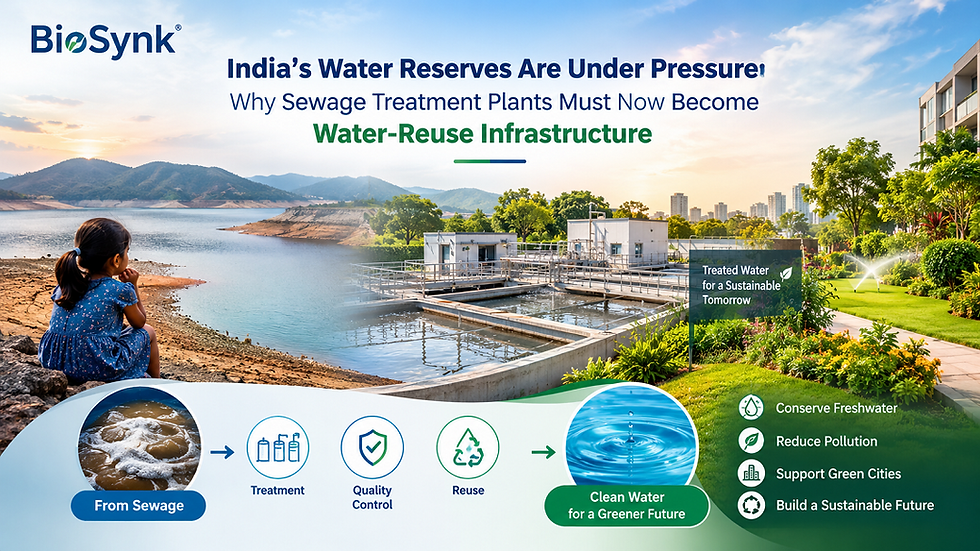
Modern sewage treatment is increasingly moving toward a treat-and-reuse approach.
Instead of treating wastewater and simply discharging it, properly treated water can potentially be reused for suitable non-potable applications depending on treatment quality, local regulations and the intended end use.
Examples can include:
Landscape irrigation
Gardening
Toilet flushing
Road washing
Vehicle washing
Cooling applications
Construction-related uses
Other approved non-potable applications
This can reduce dependence on freshwater for applications that do not require drinking-water quality.
For cities facing increasing water demand, this approach can be extremely important.
Why Every Apartment and Commercial Project Needs to Think About STPs
Large-scale municipal projects are important, but decentralized wastewater treatment also has a major role to play.
Apartments, residential communities, hotels, hospitals, schools, colleges, commercial buildings and industrial campuses generate wastewater every day.
When these facilities have appropriate sewage treatment infrastructure, wastewater can be treated closer to its source.
This can help reduce the burden on centralized sewerage infrastructure while creating opportunities for responsible water reuse.
For developers and facility owners, an STP should therefore not be considered merely as a regulatory requirement.
It should be considered part of the site's water management strategy.
The Hidden Cost of Untreated Wastewater
Untreated or poorly treated sewage can create environmental and financial problems that are often underestimated.
When wastewater enters water bodies without adequate treatment, organic pollution and other contaminants can degrade water quality.
The consequences can include unpleasant odour, polluted drainage channels, deterioration of local water bodies and increased pressure on freshwater resources.
There is also a hidden economic cost.
When treated wastewater is not reused, a facility may continue purchasing freshwater for applications such as landscaping, flushing or washing.
That means the same property can potentially be:
Using freshwater → generating wastewater → treating or disposing of wastewater → purchasing more freshwater.
A better approach is:
Use water → collect wastewater → treat it → safely reuse suitable treated water → reduce freshwater demand.
This is the foundation of a circular approach to water management.
Why Water Reuse Is Becoming More Important
India's cities are experiencing increasing pressure on freshwater resources.
Population growth, urbanisation, commercial development and industrial activity are all increasing water demand.
At the same time, climate variability and changing rainfall patterns can make water availability more uncertain.
This makes wastewater recycling increasingly important.
Every litre of wastewater that can be safely treated and reused for a suitable application can potentially reduce the requirement for an equivalent quantity of fresh water.
The objective should therefore be simple:
Do not waste water simply because it has already been used once.
Treat it. Recover it. Reuse it responsibly.
STPs Are Becoming a Critical Part of Sustainable Urban Development
The latest Delhi development demonstrates that wastewater infrastructure must grow alongside urban infrastructure.
When a new residential community, hospital, hotel, industrial facility or commercial development is planned, wastewater management needs to be considered from the beginning.
A properly planned sewage treatment system should consider:
1. Wastewater Generation
The first step is understanding how much sewage the facility generates every day.
STP capacity should be designed according to actual and projected wastewater generation rather than simply selecting a standard plant size.
2. Treatment Technology
Different sites have different requirements.
Treatment technology needs to be selected based on factors such as wastewater characteristics, required treated-water quality, available space, power availability, operation requirements and reuse objectives.
3. Space Availability
Urban projects often face severe space limitations.
This makes compact and properly engineered wastewater treatment solutions particularly valuable.
4. Treated Water Reuse
The project should determine where treated wastewater can be safely reused.
Planning reuse from the beginning can improve the overall economics of wastewater management.
5. Long-Term Operation
An STP is not simply a construction project.
It is a long-term environmental infrastructure asset.
Its performance depends on appropriate design, installation, commissioning, operation, monitoring and maintenance.
Why Underground STPs Can Be a Smart Solution
For residential and commercial developments where land is expensive, wastewater treatment infrastructure can be integrated into underground spaces.
An underground RCC sewage treatment plant can help preserve valuable surface space while keeping the treatment infrastructure largely out of sight.
For developments where appearance, landscaping and usable open space are important, underground installation can be particularly attractive.
A properly engineered underground system can allow the surface area to remain available for landscaping, roads, parking or other planned uses, while access points such as manholes remain visible for maintenance and inspection.
The Bigger Lesson From Delhi
Delhi's latest sewage treatment plant development highlights a much larger issue facing India's cities.
Building wastewater infrastructure takes time.
Planning takes time.
Tendering takes time.
Construction takes time.
Commissioning takes time.
That is why wastewater management cannot be addressed only after pollution becomes a major problem.
Cities and private developments need to plan wastewater treatment before the problem becomes critical.
The four Delhi STPs are currently at the tender stage, with construction expected to take considerably longer after tender completion.
This is a useful lesson for developers, industries and institutions planning new projects:
Wastewater treatment should be part of the project plan from day one.
India Needs to Move From Wastewater Disposal to Water Recovery
The future of wastewater management should not be based only on the question:
“How do we dispose of sewage?”
It should be based on a better question:
“How do we recover water from sewage safely and efficiently?”
This shift can help cities and organizations move toward a more sustainable water cycle.
Instead of treating wastewater as an unwanted by-product, it can be viewed as a resource that requires the right treatment technology and management.
This approach can support:
Water conservation
Reduced freshwater consumption
Sustainable urban development
Improved environmental protection
Responsible water reuse
Better wastewater management
Long-term water security
What Businesses and Developers Should Do Now
The latest Delhi wastewater development is a timely reminder for project owners across India.
If you are developing an apartment, villa community, hospital, hotel, school, college, office, IT park, industrial facility or other large development, wastewater planning should begin early.
Before selecting an STP, evaluate:
✔ Daily sewage generation
✔ Required treatment capacity
✔ Treatment technology
✔ Treated-water reuse requirements
✔ Available land or underground space
✔ Power consumption
✔ Operation and maintenance requirements
✔ Regulatory and environmental requirements
✔ Future expansion requirements
A correctly designed system can provide reliable wastewater treatment while supporting long-term water conservation.
Bio STP Solutions for Sustainable Wastewater Management
The growing focus on sewage treatment across Indian cities demonstrates why reliable wastewater treatment infrastructure is becoming increasingly important.
For residential, commercial, institutional and industrial developments, a properly designed Bio Sewage Treatment Plant can provide an effective way to manage wastewater while supporting water reuse objectives.
Bio Synk focuses on wastewater treatment solutions designed around practical project requirements, including underground RCC installation options where appropriate.
For more information about sewage treatment plant solutions, visit:
Conclusion: Wastewater Treatment Cannot Wait
The Delhi Jal Board's latest update on four proposed sewage treatment plants is more than another infrastructure announcement.
It is a reminder of the direction India's cities need to take.
As urban areas grow, wastewater generation will continue to increase. The solution cannot be to simply move sewage from one location to another.
The solution is to collect it properly, treat it effectively, monitor the treated water and reuse it responsibly wherever suitable.
Delhi's four proposed STPs may address wastewater requirements in specific areas, but the broader lesson applies across India:
Every growing city needs stronger wastewater infrastructure.
And every major development should start treating wastewater as a valuable resource—not simply as waste.
The future of water security depends not only on finding new water, but also on using the water we already have more intelligently.


Comments