
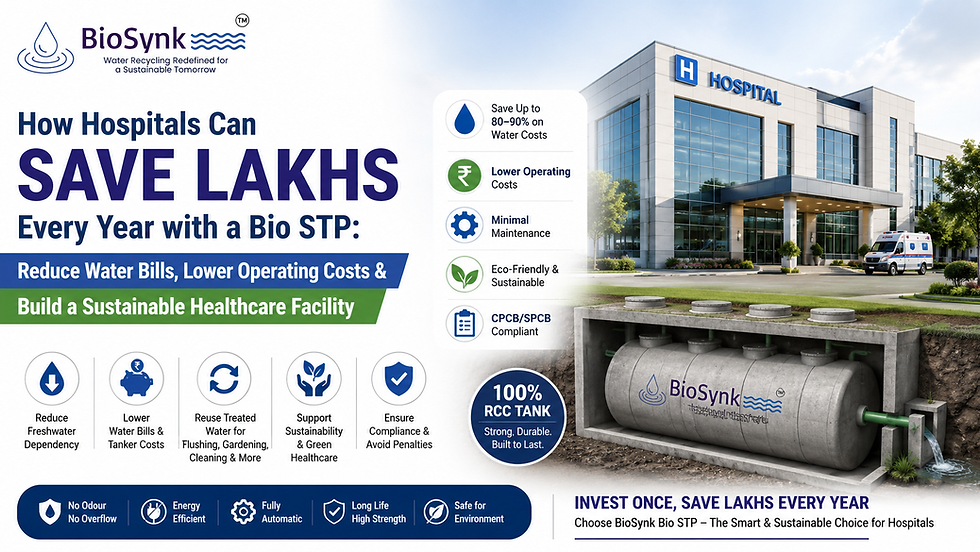
How Hospitals Can Save Lakhs Every Year with a Bio STP: Reduce Water Bills, Lower Operating Costs & Build a Sustainable Healthcare Facility
- MARKETING BIOSYNK
- 23 hours ago
- 5 min read

Introduction
Hospitals are among the most water-intensive facilities in the world. Every day, large volumes of water are used for patient care, laboratories, operating theatres, laundries, kitchens, sanitation, and housekeeping. As a result, hospitals generate significant quantities of wastewater that must be treated safely before discharge or reuse. With rising water tariffs, increasing environmental regulations, and growing pressure to adopt sustainable practices, investing in a modern Sewage Treatment Plant (STP) is no longer just a regulatory requirement—it is a smart financial decision.
A Bio STP (Biological Sewage Treatment Plant) enables hospitals to treat wastewater efficiently and reuse it for non-potable applications such as toilet flushing, gardening, cooling towers, landscaping, and general cleaning. This not only reduces dependence on freshwater but also lowers operating expenses and supports environmental compliance.
For hospital owners and administrators, a Bio STP is an investment that delivers long-term savings while strengthening the hospital's reputation as a responsible and sustainable healthcare institution.
Why Hospitals Need an Efficient Sewage Treatment System
Hospital wastewater is different from domestic wastewater because it may contain higher levels of organic matter, detergents, disinfectants, pharmaceuticals, pathogens, and other contaminants. Without proper treatment, this wastewater can pollute rivers, lakes, groundwater, and surrounding ecosystems.
Regulatory authorities require healthcare facilities to treat sewage before discharge. A properly designed Bio STP helps hospitals meet these standards while converting wastewater into a valuable reusable resource instead of allowing it to become an expensive waste product.
Major Financial Benefits of Installing a Bio STP
1. Significant Savings on Freshwater Consumption
One of the biggest advantages of installing a Bio STP is the ability to reuse treated wastewater. Hospitals consume thousands of litres of water every day, and purchasing freshwater or tanker water can become a major recurring expense.
Instead of using fresh water for every purpose, treated water can be safely reused for:
Toilet flushing
Landscape irrigation
Garden maintenance
Cooling towers
Floor cleaning
General housekeeping
This can substantially reduce freshwater demand and help hospitals save a significant amount on monthly water bills over the lifetime of the system.
2. Lower Water Tanker Expenses
Many hospitals rely on private water tankers, especially during periods of water scarcity. Tanker water prices continue to rise, increasing operational costs year after year.
By treating and reusing wastewater on-site, hospitals reduce their dependence on external water sources. The savings generated from reduced tanker purchases can contribute significantly to recovering the initial investment in a Bio STP.
3. Reduced Operating and Maintenance Costs
Modern Bio STP systems are designed for efficient operation with minimal maintenance requirements. Compared to conventional sewage treatment technologies, biological treatment systems can offer:
Lower energy consumption
Reduced sludge generation
Less chemical usage
Simplified maintenance
Reliable long-term performance
Lower operating costs mean hospital management can allocate more resources toward patient care and medical infrastructure rather than wastewater management.
Environmental Compliance Without Compromise
Hospitals must comply with pollution control regulations established by the relevant environmental authorities. Failure to treat sewage properly can result in legal issues, penalties, operational restrictions, and reputational damage.
A well-designed Bio STP helps hospitals consistently produce treated water that meets applicable discharge or reuse standards when operated and maintained correctly. This simplifies regulatory compliance and reduces environmental risks.
Sustainable Water Management
Water scarcity is becoming a growing concern across India. Sustainable water management is now an essential part of responsible healthcare infrastructure.
Every litre of treated wastewater reused within the hospital reduces the demand for fresh drinking water. Instead of disposing of valuable water resources, hospitals can create a circular water management system that conserves natural resources while lowering operating expenses.
This approach benefits both the environment and the hospital's long-term financial sustainability.
Better Hospital Environment
Clean surroundings are critical for every healthcare facility. An advanced Bio STP contributes to a healthier campus by minimizing wastewater-related problems.
Benefits include:
Reduced unpleasant odours
Improved sanitation
Cleaner surroundings
Better environmental hygiene
Enhanced patient and visitor experience
A clean and well-maintained hospital environment strengthens public confidence and supports overall healthcare quality.
Space-Saving Underground Installation
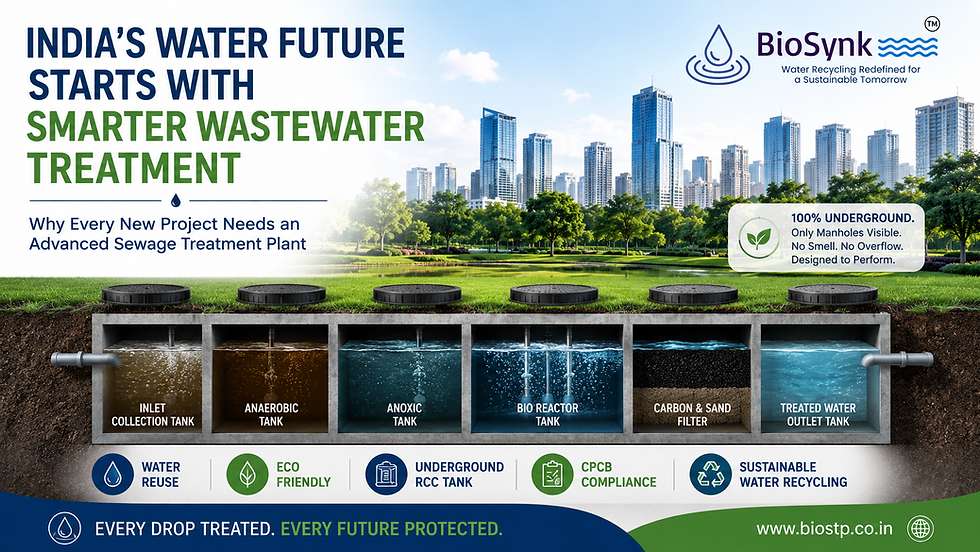
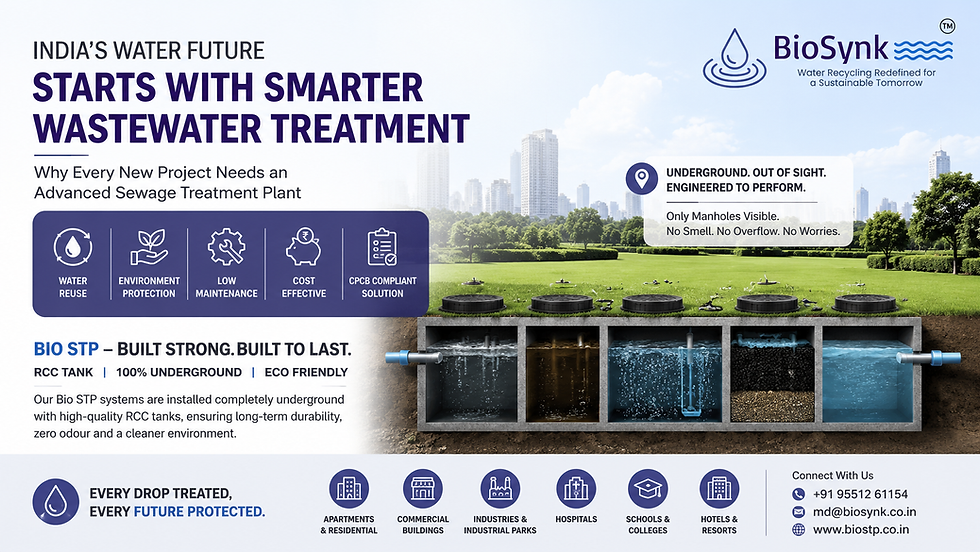
Modern Bio STP systems can be installed in underground RCC tanks, allowing hospitals to maximize the use of valuable surface space.
Only inspection covers remain visible above ground, while the treatment process operates below the surface. This makes the system ideal for hospitals where land availability is limited and aesthetics are important.
The available surface area can continue to be used for parking, landscaping, pathways, or future expansion without compromising wastewater treatment efficiency.
Long-Term Return on Investment
Although installing a Bio STP requires an initial capital investment, the long-term financial benefits often outweigh the upfront cost.
Savings are achieved through:
Reduced freshwater purchases
Lower tanker water dependency
Lower sewage management costs
Reduced maintenance expenses
Better operational efficiency
Extended infrastructure sustainability
Over time, these cumulative savings can provide an attractive return on investment while protecting the hospital from rising utility costs.
Supporting Green Healthcare Initiatives
Patients, healthcare professionals, and regulatory authorities increasingly expect hospitals to adopt environmentally responsible practices.
A Bio STP demonstrates a commitment to:
Water conservation
Pollution prevention
Sustainable infrastructure
Responsible resource management
Environmental stewardship
These initiatives enhance the hospital's reputation and contribute to broader sustainability goals.
Choosing the Right Bio STP
Selecting the appropriate sewage treatment system is just as important as deciding to install one. Hospital owners should evaluate factors such as:
Daily sewage generation capacity
Future expansion plans
Available installation space
Automation features
Energy efficiency
Ease of maintenance
Treated water quality
Service and technical support
Partnering with an experienced Bio STP provider ensures the system is properly designed, installed, and maintained for reliable long-term performance.
Conclusion
Hospitals are responsible not only for protecting human health but also for protecting the environment. Every litre of wastewater that is safely treated and reused reduces freshwater consumption, lowers operating expenses, and supports sustainable healthcare infrastructure.
A modern Bio STP transforms wastewater from an operational burden into a valuable resource. By reducing water bills, minimizing maintenance costs, improving environmental compliance, conserving natural resources, and enabling treated water reuse, hospitals can save substantial operating costs while contributing to a cleaner and greener future.
As healthcare facilities continue to expand across India, investing in an advanced Bio STP is no longer simply about meeting regulations—it is about building a resilient, cost-efficient, and environmentally responsible hospital for the future.
Why Choose Bio Synk for Hospital Sewage Treatment Plants?
Bio Synk offers advanced biological sewage treatment solutions specifically designed for hospitals, medical colleges, healthcare campuses, and multispecialty facilities.
Our systems are engineered to deliver reliable wastewater treatment with efficient biological processes, low operational requirements, and high-quality treated water suitable for approved non-potable reuse applications. With customizable capacities, underground RCC installation options, automation, and dedicated technical support,
Bio Synk helps hospitals reduce water consumption, improve operational efficiency, and move toward sustainable healthcare infrastructure while meeting applicable environmental standards.

Comments